Thursday, October 26, 2006

Sudan: Blog bites man


UN envoy Jan Pronk, former Dutch diplomat, was expelled from Sudan over the weekend. The reason given was his ongoing criticism of government atrocities in Darfur described on his blog, which is always a good read. A contentious figure in the humanitarian community working in Darfur, I have always appreciated Pronk for his classic Dutch directness, and fearlessness in the face of government intimidation and opposition to aid efforts. He worked tirelessly to increase access of humanitarian agencies to targeted populations, and worked tirelessly behind the scenes to get imprisoned or kidnapped aid workers released.

AFP reported today, "Sudan will not have any further dealings with expelled UN envoy Jan Pronk, regardless of what the United Nations may decide about his future, a senior official said Thursday.

"The decision to expel Jan Pronk is irrevocable because of positions he has taken that are incompatible with his mission in Sudan," foreign ministry spokesman Ali al-Sadek told journalists.

The Sudanese military had accused him of "waging psychological warfare on the armed forces by propagating erroneous information."

[...] Pronk has long been a thorn in the side of the Khartoum government. He has openly called Sudan a "police state" and said refugees in Darfur were victims of "Arabic racism"."

Read rest of AFP article here.

Chad: timeline of the rebellion


IRIN News offers a useful summary of the rebellion against the Deby regime in Chad, active since late 2005:

"There have been at least a dozen attacks by rebels opposed to Chad’s president and skirmishes with the Chadian army in the last 12 months. After briefly occupying the southeastern Chadian towns Am Timan and Goz Beida this week, the rebels again melted away into the desert on Wednesday, according to a Chadian government spokesman."

Wednesday, October 25, 2006

DRC elections: SADC monitors cannot communicate

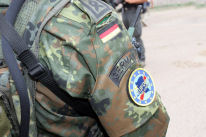
Representatives from the Southern African Development Community, or SADC, are present in force here in Kinshasa, apparently to monitor elections scheduled for this Sunday, October 29. All the high end hotels (all two of them) are overbooked with election monitors and military from the European Union Force or EUFOR, a supplementary military force here to ensure calm during and shortly after the elections.

All are used to foreign militaries parading around this country, some were belligerents in the war, others here ostensibly to keep the peace. None of them spoke a single word of French or any local language, yet both groups managed to abuse and exploit local women and girls. Foreign armies, such as Uganda, Rwanda, Angola and Zimbabwe, remain above the law--surprise. But UN Peacekeepers have experienced a serious crackdown on their interaction with locals, particularly regarding sexual contact.

A minimum of communication skills ares obviously essential to ensuring positive relations with the local population that foreigners are here, for the time being, to protect and serve. And, not least, to get one's job done. But the wave of SADC officials and election monitors preparing to be dispatched across the country, none of whom speak any French or local language, sets the stage for an epic theatre of the absurd. Imagine the emphatic gesticulations and deaf mute grunts that will ensue as ballot boxes are analyzed and voting procedures contested between SADC drones and the Congolese. I hope someone films the interactions as evidence of the colossal waste of the SADC intervention.

Thabo Mbeki, South Africa's president and a major force behind SADC, has always advocated for 'African solutions to African problems'. Surely a common language should be a key competency before intervening in another's sovereign affairs.

Thursday, October 19, 2006

DR Congo: Gov't soldiers abducting civilians

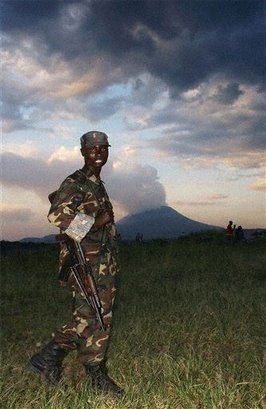
This AP file photo shows a freshly uniformed government soldier walking in the fields around Goma, with its active volcano smoldering in the background. Government soldiers of the FARDC, or DRC Armed Forces, are the product of a long and expensive process of security sector reform, in which all former combatants (including rebels, ethnic militias, and popular defense forces) are disarmed, demobilized and reintegrated (DDR) either into civilian or military life, depending on their capacities.

Human Rights Watch recently released a report documenting a well known but troubling reality about the success of the country's DDR program : troops
from the 'new', reformed government army are responsible for massive human rights abuses, in particular the abduction of civilians for manual labor. Digging and sifting in open mines for coltan, diamonds and gold is one such activity, ostensibly to offset the lack of salary received from their superiors in Kinshasa.

"Congolese government soldiers were sent to Ituri to protect civilians against abuses by local militias, but they themselves are devastating the area," writes Alison Des Forges, Africa adviser at Human Rights Watch.

I will be in the DRC for the next six weeks, so expect more blogging from there. Especially as the 29 October elections approach. My camera was stolen on my last visit in June. I haven't replaced it, so will have to crib others' photos, alas.

Sunday, October 15, 2006

DRC: Democracy is no panacea

Writing this week for "The New Statesman", Michela Wrong, author of In the Footsteps of Mr. Kurtz and more recently I Didn't Do It For You, gazed with fresh eyes on the problems brewing in Kinshasa in advance of the 29 October elections.

"This is not hysteria," she writes, "the ingredients for serious trouble are all in place. A new form of xenophobia between Lingala-speaking westerners, who regard themselves as "sons of the soil", and Swahili-speaking easterners, rejected as "foreigners", is being stoked by television stations owned by the two candidates. Unpaid soldiers, whose wages are routinely pocketed by their commanders, roam at will. Both men control private armies that opened fire on each other after the first round of voting, leaving 30 dead, and have been importing weapons ahead of the coming showdown. Whoever loses is certain to denounce the results as rigged. Both Kabila and Bemba, after all, are men who owe their prominence to their readiness to take up arms, so why accept the verdict of the polls?"

She concludes, "If all hell breaks loose in the DRC after 29 October - and I desperately hope it does not - it will be tragic evidence of the damage a very human inclination to hope for the best can do."

But is exporting democracy--in this case with a $420 million price tag--the best the international community can do? Most ordinary Congolese lament the lack of tangible benefits to their individual lives and to society generally. Congo needs administrative structures, a capable bureaucratic class to operate these structures, and leaders capable of managing the mechanisms of modern statehood. Can such core necessities simply be bought? Of course not, only the Congolese can provide the human element.

Elections themselves are window dressing, all would agree, and if peaceably implemented, could lend legitimacy to Congo's status in a world of states. But as William Swing, the Secretary General's envoy to Congo, said last week in Kinshasa, if elections go well and the results are accepted by the losing party --but nothing improves in the country, then that $420 million will have been a complete waste.

Friday, October 13, 2006

Washington Post: UN reform falling flat

Yesterday the Washington Post editorial page published what amounts to an epitaph of reform efforts at the United Nations, in particular its Human Rights Council. The author described reform efforts aimed at the Council as having 'run amok', and as 'making the old one look good' ("Reform Run Amok").

The old one, we recall, sported the likes of Sudan, China and Libya as Council member states. Attention was successfully diverted from Darfur and Uzbekistan, and focused exclusively on Israeli 'atrocities' in Lebanon and Palestine. The exclusive focus on Israel was possible, according to Mallaby, thanks to Council rules allowing one-third of its membership to effectively run proceedings unilaterally. 17 of the 47 member states happen to be partisans of a so-called 'Organization of the Islamic Conference', and are thus able to sustain their screeching anti-Israel rhetoric while Darfur burns, China and Russia imprison and murder their journalists, and Guantanamo persists.

The editorialist maintains, "For all its faults, the previous U.N. commission occasionally discussed and condemned the regimes most responsible for human rights crimes, such as those in Belarus and Burma. China used to feel compelled to burnish its record before the annual meeting. The new council, in contrast, has so far taken action on only one country, which has dominated the debate at both of its regular meetings and been the sole subject of two extraordinary sessions: Israel."

"[...] Human rights groups that supported the creation of the council, such as Human Rights Watch and Amnesty International, admit to being appalled by the outcome; they nevertheless argue that the panel should be given time to right itself. That could happen, they say, if the democratic members of the council organize and work with the same cohesion as the "unfree" states. They also suggest that the United States, which refused to join the council, reconsider."


Personally, I have tended to withhold judgment on the success or failure of the UN's declared reform efforts given their sweeping and comprehensive nature. They will take time, and lots of dead wood will have to go. One can imagine many insiders will resist the process, like derelict renters facing eviction. [Having waited a full five months to get paid for a job I did for UNICEF in May of this year, I know intimately the unseemly odor and ungainly heft of the UN's administrative dead wood.] But widespread reform is urgent and imperative, and many UN careerists admit this.

Kofi Annan rightly recognized that the logical starting place was to fix one of the most glaring blemishes on the UN's tattered face, that of its infamously dysfunctional Human Rights Council. Why exactly this failed so egregiously is unclear. Mallaby recommends cutting off US funding, as happened to UNESCO in the 1980s. The UN only further undermines its waning credibility by allowing such anti-Zionist forums to abide and prosper.

Wednesday, October 11, 2006

DR Congo: Amnesty Int'l claims child DDR programs are 'failing'

DDR is the process by which ex-combatants from rebel and government forces are disarmed, demobilized and reintegrated into civilian life. Those who pass certain tests are allowed to remain in the national army, the remaining adults are given a short-term stipend and some vocational training.

Minors, of whom there were an estimated 30,000 associated with armed groups in the DRC, qualify only for civilian life. They are automatically demobilized and reintegrated because their association with armed groups is prohibited by international humanitarian law and a clutch of related international treaties and conventions specific to the rights of children. The work of de-militarizing their minds and acclimating them to school, village life with their family, the poverty and monotony of the life they left behind, is still an experiment. Programs differ significantly from country to country, as new methods are tried in light of past failures. The children dont get any 'better' at the programs, and are generally very difficult to work with, in addition to being violent.

In 2005 and 2006 I've been working in and evaluating several such programs in Burundi and DR Congo. It has been fascinating, but also enormously frustrating. There is always much to criticize in any aid program. Things rarely go as planned and measuring impact in highly insecure and fluid environments is notoriously difficult.

But DDR is unlike any other aid effort because of its close links with human security and its centrality to the pacification of the country itself. It's no exaggeration to say that a poorly executed DDR program adds a new powderkeg to an already volatile situation, and can re-ignite widespread violence when participants decide to withdraw from the program. The consequences of poor performance in other types of aid programs, like emergency nutrition or medical services, do not include returning the country to war. This happened in Liberia: failed DDR programs in the late 1990s meant a return to war. A new
international commitment to bring belligerents back to the negotiating table took much time and money, and only then could another DDR program get
underway.


This week, Amnesty International released its independent investigation into the success of child DDR efforts in DR Congo, called "Children at war, creating hope for the future."

BBC covered the story, highlighting the fact that the "missing 11,000" children are girls "used as sex slaves by military commanders or regarded as dependents of adult fighters." Girls made up 40% of the children taken by armed groups during the war yet the vast majority remain unaccounted for, according to Amnesty. "A lot of them were used more as sex slaves and therefore the combatants are considering them as their possession or their wife," Amnesty researcher Veronique Albert told the BBC.

It is an accurate claim. Girls associated with armed groups--often abducted by force, sometimes joining voluntarily--have proven nearly impossible to access and get released by soldiers and rebels
alike. There are many reasons for this, most of them cultural: the end result is that many girls choose to stay with these men, with whom they now have children. Read Amnesty's press release here.

With the second round of presidential elections approaching on 29 October, I dont think the problems with the DDR program pose a great risk to a peaceful outcome. There is already enough hate speech circulating and private militias
waiting in the wings, to deliver a crippling blow to the country's recovery. Today's report about Kabila's party representatives in London getting assaulted by a mob of Bemba supporters is indicative of the overt tensions around elections.

Tuesday, October 10, 2006

Chad: Conflict spills over from Darfur


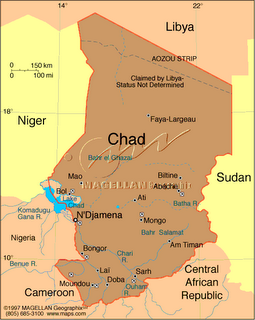
For the first time, heavy fighting between Sudanese rebel groups and the government of Sudan has spilled across the border from the embattled Darfur region into eastern Chad, IRIN new service reported yesterday. Previously, such clashes had involved the Chadian army in pursuit of rebels seeking to oust Chadian President Idriss Deby.

"Fighting spread into Chad after wounded fighters started scattering, according to reports. 80 of them have congregated at a refugee camp in Oure Cassoni, the UN refugee agency (UNHCR) and the International Committee of the Red Cross (ICRC) said.

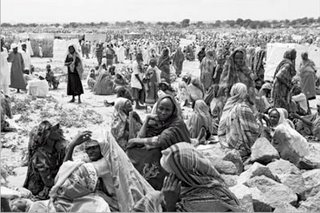
A dozen refugee camps in eastern Chad host about 250,000 Sudanese who have fled looting, raping and killing in the neighbouring Darfur region of Sudan. At least 200,000 people have been killed in the violence in Sudan and more than 2.5 million have been displaced.

The camp at Oure Cassoni is less than 20 km from the Chad-Sudan border and 400 km northeast of the aid hub Abeche."


Monday, October 09, 2006

Darfur: Bearing witness to civilian massacres

Just when aid efforts in highly militarized zones such as Darfur begin to seem futile, their compassion a drop in an ocean of unchecked cruelty, one of their core raisons d'etre returns to view.

Reports, communiques and eye witness testimonies of civilian atrocities are one among several options in the humanitarian tool box. Sudanese government forces and their proxy militias have resumed their campaign against civilians across Darfur, and the heightened levels of violence make access and mobility difficult for aid agencies. The government claims it has returned to its rightful mission of clearing the state of insurgents. Witnesses say the attacks are indiscriminate and intended to decimate and terrorize specific civilian groups, whether they are armed or not.

An exerpt from a recent interview with operations directors of Doctors Without Borders captures the difficulties of responding effectively in Darfur, where twelve aid workers have been killed since June 2006 alone. "We are currently reaching the limits of our assistance. We do not have access to people who are directly affected by the conflict. [...] Today, the survival of populations in pockets where humanitarian assistance was still possible is jeopardized. Because of the lack of security, some of our operations in the field has been temporarily suspended, or continue with a smaller number of aid workers. Another consequence is that all our mobile medical activities, which target especially nomadic populations, had to stop."

Despite these difficulties, many agencies continue to document and report on ongoing atrocities, particularly against women. Rape of Darfuri women and girls is regular practice for government militias aiming to terrorize the population, break up families and destroy individual lives.

Documentation and public condemnation of the practice by aid agencies and human rights groups has been strident since war broke out in 2003. Government spokesmen dismiss the reports as 'Western propoganda', but will arrest aid workers involved in treating and documenting rape to dissuade them. So goes the debacle.

A UN communique today denounced the practice: "The rising rate of violence against women and children is increased by the participation of many different groups in these crimes. Warring parties seeking retribution against their opponents by inflicting humiliating punishment on civilians are flagrantly disregarding their obligations under international law. Moreover, there is scant evidence that culprits are being actively sought, let alone punished, for their crimes." [read the UN communique]

The Office for the High Commission of Human Rights, known as OHCHR, just published a detailed collection of testimonies documenting recent events in which "300 to 1000 armed militia from the Habbania Arab tribe carried out a series of attacks on some 45 villages in the Buram locality of South Darfur in late August. The attacks were reportedly marked by widespread targeting of civilians from tribes of “African” origin, wholesale burning of villages, looting and forced displacement. The population of the villages attacked is estimated to be about 10,000 people, mainly of the Zaghawa, Massalit and Misserya Jebel tribes.The attacks appear to have been conducted with the knowledge and material support of Government authorities, and the death toll is estimated to be as many as several hundred civilians."

There is one sign of hope in all this tragic reporting: at least there are people on the ground to document and bear witness to the seemingly relentless violence committed by government forces, and Darfuri rebel groups as well, against civilians.

Tuesday, October 03, 2006

UN Assembly: Annan's departure speech

I've been meaning to post this for a while; it was delivered in late September in New York. It's the usual optimism about the state of the world one expects from those in high public office, none of whom seem to want to admit that the planet is going up in a pyromaniac flame-throwing frenzy. That said, I admire the man and his cause. His remarks about terrorism are interesting, and it is refreshing to be reminded that the UN is not the pious adherent of the pro-globalization orthodoxy so common on these shores. More cash for the rich does not float all boats. Here's the speech in full:

Madam President, Excellencies, Ladies and Gentlemen,

When I first spoke to you from this podium, in 1997, it seemed to me that humanity faced three great challenges. One was to ensure that globalization would benefit the human race as a whole, not only its more fortunate members. Another was to heal the disorder of the post-cold-war world, replacing it with a genuinely new world order of peace and freedom, as envisaged in our Charter. And the third was to protect the rights and dignity of individuals, particularly women, which were so widely trampled underfoot.

As the second African to serve as Secretary-General, I felt that all three of these challenges-- the security challenge; the development challenge; the challenge of human rights and the rule of law -- concerned me directly.

Africa was in great danger of being excluded from the benefits of globalization -- indeed, of being left to rot on the margins of the world economy. Africa was also the scene of some of the most protracted and brutal conflicts.

And many of Africa's people felt they were unjustly condemned to be exploited and oppressed, generation after generation, since colonial rule had been replaced by an inequitable economic order on the global level, and sometimes by corrupt rulers and warlords at the local level. In the decade since then, many people have been struggling to confront these three global challenges.

Much has been achieved, but events have also presented us with new challenges -- or rather, have given the old ones new form, or a sharper bite.

In the economic arena, both globalization and growth have continued apace. Some developing countries, notably in Asia, have played a major role in this growth. Many millions of their people have thereby been released from the prison of perpetual poverty. Meanwhile, at the level of development policy, the debate has advanced, moving from rival models to agreed targets. And the world has now recognized HIV/AIDS as a major challenge to development, and begun to confront it. I am proud of the role the United Nations has played in this.

Development, and the Millennium Development Goals, now take pride of place in all our work. But let's not delude ourselves. The Asian miracle is yet to be replicated in other parts of the world. And even within the most dynamic Asian countries, its benefits are far from equally shared. By the same token, the Millennium Goals are unlikely to be achieved everywhere by 2015.

True, in many developing countries there is now a much better understanding of what good governance is, and why it's important. But many still fall short of it in practice. True, there is progress on debt relief, as well as encouraging promises on aid and investment. But the 'global partnership for development' is still more phrase than fact -- especially in the all-important area of trade. My friends, globalization is not a tide that lifts all boats. Even among those who the statistics tell us are benefiting, many are deeply insecure, and strongly resent the apparent complacency of those more fortunate than themselves. So globalization, which in theory brings us all closer together, in practice risks driving us further apart. Are we any more secure against the second challenge -- the ravages of war?

Again, some statistics would tell us so. There are fewer inter-state conflicts than there used to be; and many civil wars have ended. Here too, I am proud of the United Nations' role in this. And I am proud of what my fellow Africans have achieved in ending many of the conflicts that disfigured our continent. But here too, we should be under no illusion.

In far too many parts of the world -- especially the developing world -- people are still exposed to brutal conflicts, fought with small but deadly weapons. And people in all parts of the world are threatened -- though some are more aware of it than others -- by the spread of weapons of mass destruction. It is shameful that last year's Summit Outcome does not contain even one word about non-proliferation and disarmament, basically because states could not agree which of the two should be given priority. It is high time to end this dispute, and tackle both tasks with the urgency they demand. Moreover, just as some who benefit from globalization may feel threatened by it, so, many who are statistically safer from conflict do not feel safe.

For that, we have terrorism to thank. It kills and maims relatively few people, compared to other forms of violence and conflict. But it spreads fear and insecurity. And that in turn drives people to huddle together with those who share their beliefs or their way of life, while shunning those who appear 'alien'.

Thus, at the very time when international migration has brought millions of people of different creed or culture to live as fellow-citizens, the misconceptions and stereotypes underlying the idea of a 'clash of civilizations' have come to be more and more widely shared; and insensitivity towards other people's beliefs or sacred symbols -- intentional or otherwise -- is seized upon by those who seem eager to foment a new war of religion, this time on a global scale. Moreover, this climate of fear and suspicion is constantly refuelled by the violence in the Middle East.

We might like to think of the Arab-Israeli conflict as just one regional conflict amongst many. But it is not. No other conflict carries such a powerful symbolic and emotional charge among people far removed from the battlefield. As long as the Palestinians live under occupation, exposed to daily frustration and humiliation; and as long as Israelis are blown up in buses and in dance-halls: so long will passions everywhere be inflamed.

On one side, supporters of Israel feel that it is harshly judged, by standards that are not applied to its enemies -- and too often this is true, particularly in some UN bodies.

On the other side, people are outraged by the disproportionate use of force against the Palestinians, and by Israel's continued occupation and confiscation of Arab land. As long as the Security Council is unable to end this conflict, and the now nearly 40-year-old occupation, by bringing both sides to accept and implement its resolutions, so long will respect for the United Nations continue to decline.

So long, too, will our impartiality be questioned. So long will our best efforts to resolve other conflicts be resisted, including those in Iraq and Afghanistan, whose peoples need our help just as badly, and are entitled to it. And so long will our devoted and courageous staff, instead of being protected by the blue flag, find themselves exposed to rage and violence, provoked by policies they neither control nor support.

But what about the third great challenge facing humanity: the challenge of the rule of law, and our rights and dignity as human beings? Here, too, there has been significant progress. More rights have been enshrined in international treaties -- and this Assembly is now about to codify the rights of a group who particularly need it: people who suffer from handicaps and disabilities. More governments today are elected by, and are accountable to, those whom they govern.

Humanity has actually brought to justice some of those who committed the most heinous crimes against it. And this Assembly, meeting last year at the highest level, has solemnly proclaimed the responsibility -- of each individual State in the first instance, but ultimately of the whole international community, acting through the United Nations to protect populations from genocide, war crimes, ethnic cleansing and crimes against humanity. And yet.

And yet. Every day, reports reach us of new laws broken; of new bestial crimes to which individuals and minority groups are subjected. Even the necessary and legitimate struggle around the world against terrorism is used as a pretext to abridge or abrogate fundamental human rights, thereby ceding moral ground to the terrorists and helping them find new recruits. Sadly, once again the biggest challenge comes from Africa --from Darfur, where the continued spectacle of men, women and children driven from their homes by murder, rape and the burning of their villages makes a mockery of our claim, as an international community, to shield people from the worst abuses. In short, Madam President, the events of the last ten years have not resolved, but sharpened, the three great challenges I spoke of an unjust world economy, world disorder, and widespread contempt for human rights and the rule of law. As a result, we face a world whose divisions threaten the very notion of an international community, upon which this institution stands.

And this is happening at the very time when, more than ever before, human beings throughout the world form a single society. So many of the challenges we face are global. They demand a global response, in which all peoples must play their part.

I deliberately say 'all peoples', echoing the preamble of our Charter, and not 'all states'. It was clear to me ten years ago, and is even clearer now, that international relations are not a matter of States alone. They are relations between peoples, in which so-called 'non-state actors' play a vital role, and can make a vital contribution. All must play their part in a true multilateral world order, with a renewed, dynamic United Nations at its centre. Yes, I remain convinced that the only answer to this divided world must be a truly United Nations. Climate change, HIV/AIDS, fair trade, migration, human rights -- all these issues, and many more, bring us back to that point.

Addressing each is indispensable for each of us in our village, in our neighbourhood, and in our country. Yet each has acquired a global dimension that can only be reached by global action, agreed and coordinated through this most universal of institutions. What matters is that the strong, as well as the weak, agree to be bound by the same rules, to treat each other with the same respect. What matters is that all peoples accept the need to listen; to compromise; to take each other's views into account. What matters is that they come together, not at cross purposes but with a common purpose: a common purpose - to shape their common destiny. And that can only happen if peoples are bound together by something more than just a global market, or even a set of global rules.

Each of us must share the pain of all who suffer, and the joy of all who hope, wherever in the world they may live. Each of us must earn the trust of his fellow men and women, no matter what their race, colour or creed, and learn to trust them in turn. That is what the founders of this Organization believed in. It is what I believe in. It is what the vast majority of people in this world want to believe in. And that is what has spurred the reforms and new ideas of the United Nations over the last frenetic decade.

From peacekeeping to peacebuilding, from human rights to development and humanitarian relief, I have been lucky enough to preside over the Secretariat -- and its wonderful, devoted staff at a time when your ambitions for the Organization have sometimes seemed limitless -- although your pocket books less so. These last few weeks, especially, as I travelled through the Middle East, I saw again the legitimacy and the reach of the United Nations. Its indispensable role in securing the peace in Lebanon has reminded us all how powerful this Organization can be, when everyone wants it to succeed.

Madam President, dear friends: This is the last time I shall have the honour of presenting my annual report to this Assembly. Let me conclude by thanking you all for allowing me to serve as Secretary-General during this remarkable decade. Together we have pushed some big rocks to the top of the mountain, even if others have slipped from our grasp and rolled back. But this mountain with its bracing winds and global views is the best place on earth to be. It's been difficult and challenging, but at times thrillingly rewarding. And while I look forward to resting my shoulder from those stubborn rocks in the next phase of my life, I know I shall miss the mountain. Yes, I shall miss what is, when all is said and done, the world's most exalting job. I yield my place to others with an obstinate feeling, a real obstinate feeling of hope for our common future. Thank you very much.

Monday, October 02, 2006

Peacekeeping missions extended in Liberia, DRC, Ethiopia/Eritrean border


The UN Security Council voted unanimously today to extend the mandates of the United Nations peacekeeping missions in Eritrea and Ethiopia, the Democratic Republic of the Congo (DRC) and Liberia, which would have otherwise expired at the end of this month.

Council members adopted resolutions extending the UN Mission in Eritrea and Ethiopia (UNMEE), the UN Organization Mission in the DRC (known by its French acronym MONUC), and the UN Mission in Liberia (UNMIL). UNMEE has been extended until 31 January 2007, MONUC’s authority continues through 15 February 2007 and the mandate of UNMIL is now extended until 31 March 2007.

Read the full press release here.

The three peacekeeping contexts face very different challenges, yet all are equally central to building environments conducive to reconstruction and regional stability. All three contexts form each a unique epicenter of far-reaching regional tensions and cross-border interference that have caused much suffering and little political gain for the last 10 - 15 years.

How Charles Taylor's Liberia and Congo's conflict destabilized their respective regions and claimed millions of lives are well known. Less covered in the popular press is the degree to which Eritrea and Ethiopia have competed for dominant influence in both the Sudanese conflict (North & South, Darfur, and more recently the East), and in Somalia. There, Eritrea reportedly backs the Union of Islamic Courts (UIC) while Ethiopia supports the feeble regime of President Ghedi, a product of western-financed mediations in Nairobi over the last 8 years. That Ghedi has been calling for a return of UN peacekeepers further allies him to the detested international community.

Congo will surely need the peacekeepers through 2007 to help control the probable violence that will follow the 29 October electoral showdown between presidential hopefuls Kabila and Bemba. International Crisis Group just released a report about the 'state of the state' in the buildup to this important date in Congolese history.

"Because both Kabila and Bemba will be tempted to use violence should they lose the second round, and the former in particular is very strong militarily, the Congolese government and the international community must move quickly to make secure the run-off as well as the provincial assembly elections on 29 October. Militias also threaten stability elsewhere in the country, notably in North Kivu and Ituri, but the capital is likely to be the most sensitive location again."

Read more from the ICG report here.

Take a tour: Kim Gjerstad's Congo


Check out this blog from Kinshasa by Kim Gjerstad, whom I've met a couple of times. The photos are particularly impressive. Images from the Ruwenzori mountains, long inaccessible because of insecurity, are stunning. Also see his photos from Salonga national parks (I&II), which few outsiders have ever visited owing to their geographic inaccessibility deep in the center of the country where roads have long been reclaimed by nature.

Here's yesterday's posting.

Street Kids Get Political and Get Locked Up

Top: street kids rioted in town two weeks ago.
Bottom: they've been catching them and locking them up since.

Kim writes: "Life without street kids is awesome. Last week, my flat mate, Tim, and I discovered the joy of walking free. Kinshasa’s main throughway, the infamous Boulevard 30 Juin, was peaceful. “The city feels like a normal city!” cried out Tim. So fine it was, we went for pleasure stroll, the first in three years."

Yes, you read that correctly. Kinshasa is not yet a place for the defenseless pedestrian. Nor has it been since 1991, the first time (of many) that I've been evacuated from there.

[read/see more here]

Tuesday, September 26, 2006

Images from Mogadishu

Some more photos from the NYT Sunday article on life in Mogadishu and changes since the takeover by the Union of Islamic Courts (UIC).

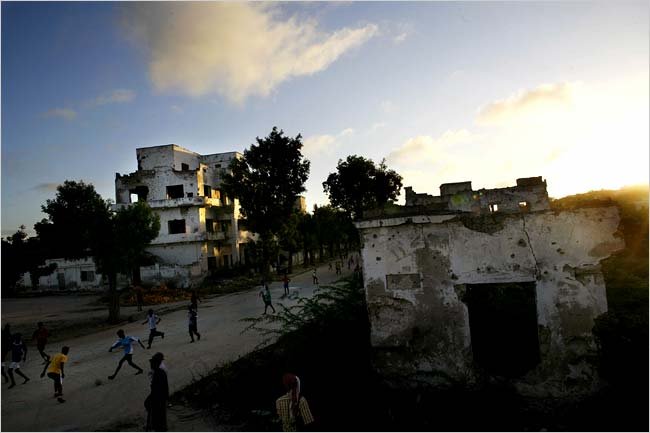
The former Mogadishu municipality buildings built by Italy in the late 1920's are now destroyed and riddled with bullet holes.


Military recruits jog in formation during an exercise. Former fighters allied to the warlords who previously ran Mogadishu now train at a military camp run by the Islamists.


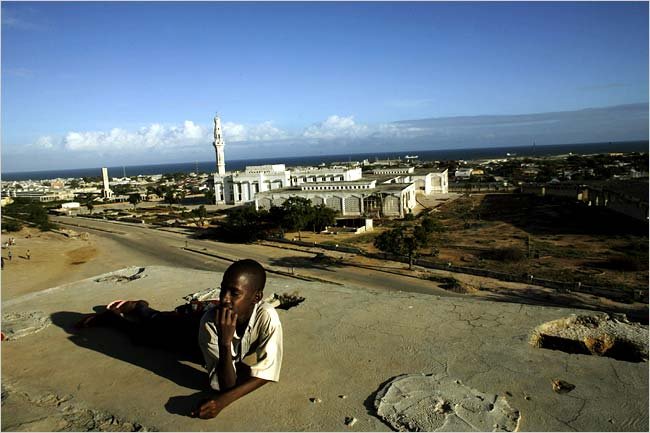
A boy lays out in front of Mogadishu's largest mosque, The Islamic Solidarity Mosque, seen in the distance.

Photos: Jehad Nga for the NY Times


This BBC map shows UIC areas of control after the taking of Kismayo, and the enclave that remains of Baidoa, where Ethiopian troops are currently coming to the aid of President Ghedi, who was chased from the capital earlier this year.

Monday, September 25, 2006

Somalia: Islamists pacify Mogadishu; setbacks in Kismayo

It may be premature to pronounce on 'peace returning to Mogadishu', but the recent gains in territory by the Union of Islamic Courts (UIC--yes, they're on the US terrorist list) are offering enough stability for local commerce and schooling to resume at a level unseen in years. Primary schools are mixed gender, and soccer is allowed--not what anyone expected from the UIC, who were tagged with the Taliban label early on.

Yet extremist elements are still prevalent in areas under UIC control. Witness the murder of an Italian nun in a Mog hospital last week, an apparent retaliation for the Pope's citation of a 1500 year-old quote about Islam.

Yesterday the NY Times covered life under the UIC:

"... It is hard to imagine that this is Mogadishu, the same Mogadishu of “Black Hawk Down,” and clan against clan and 15 years of anarchy. But over the past three months, the Islamists in control here have defied international expectations — in many ways. Not only have they pacified one of the most dangerous cities in the world, they also seem to have moderated their message."

“Nobody knows where we’re headed,” said Ahmed Mohammed Ali, chairman of a Mogadishu human rights organization. But, he added, the Islamists “pacified this place and brought the clans together. Whatever you think about them,” he said, “you can’t overlook that.”

This morning in Kismayo, the second largest city about 500km south of Mog, UIC troops entered and took the town unopposed. Civilians gathered to welcome their arrival, but well-armed local khat traders organized a protest, which turned violent.

UIC plans to ban the lucrative khat trade, and the daily supply flights from Nairobi that keep the population munching on the bitter green twigs. The US military tried to shut down the khat trade when they arrived in 1992 (setting fire to tons of the stuff) and triggered the hatred of Somalis that would ultimately drive them from the country in shame. Perhaps the Islamists will offer some sort of compromise.

Also this morning, dozens of trucks carrying Ethiopian troops rolled across the border towards Baidoa, the residence in exile for the beleaguered Somali President who suffered an assassination attempt last week. I'm very curious to see how the region would respond a possible confrontation between Ethiopian troops and the local Islamists. My Somali taxi drivers here in Washington are already seething with rage at the audacity of their Ethiopian neighbors.

Tuesday, September 19, 2006

From life to death: the visual contrasts of Darfur

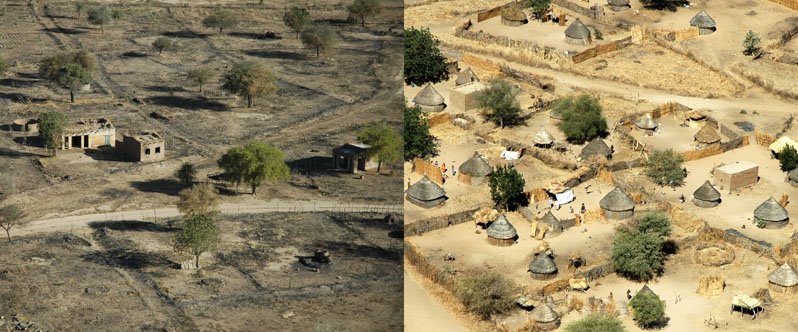
Here are some photos from Darfur by Michael Wadleigh that juxtapose 'before' and 'after' to capture the brutality to which civilians are subjected by their government.


Aerial view of villages burned and spared ...


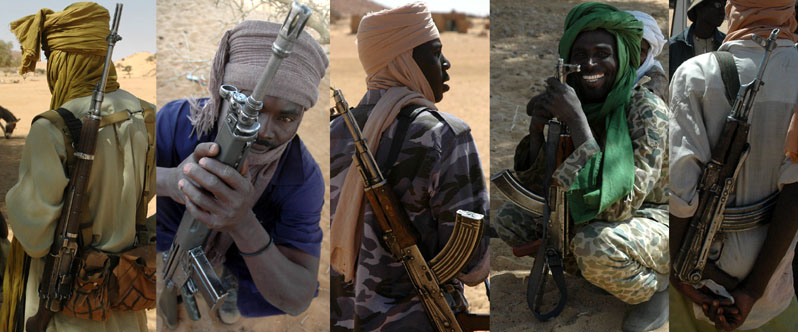
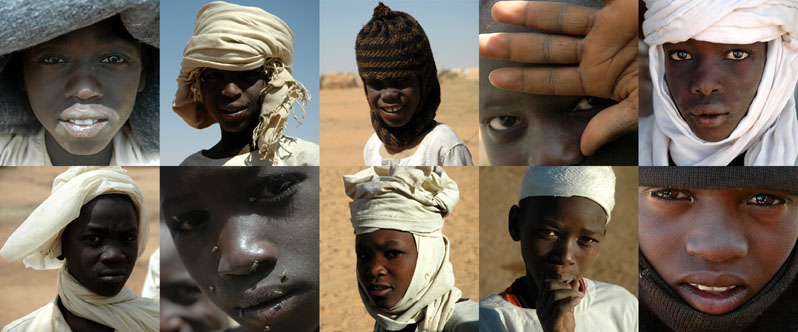
Faces of assorted combatants...


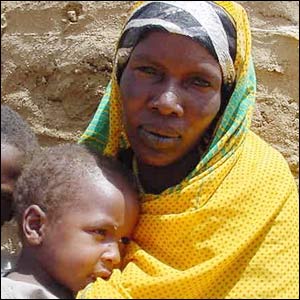
The emptiness of Darfur and the vulnerability of its inhabitants...


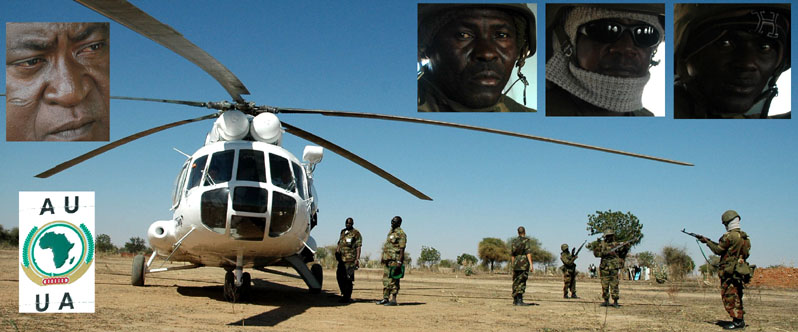
The AU forces scheduled to leave end September...

Monday, September 18, 2006

Darfur: the politics of mortality figures

The politically-charged and potentially lethal business of putting an exact figure of the number of victims in Darfur has raised its head again. Reuters just ran a story on some new mortality figures released in the academic journal Science, in an article called "Death in Darfur."

"We conclude that the death toll in Darfur is conservatively estimated to be in the hundreds of thousands rather than tens of thousands of people," John Hagan and Alberto Palloni write in their report. "There is no census data, there is no counting of the bodies and so we use surveys to try and set our foundation of the knowledge," Hagan said.

"What we have done is to take seven of these surveys, five of them done by the Medecins Sans Frontieres ... two done by the World Health Organization," Hagan said. "By spreading them out, initially you can get very good information on one of the three (affected) states, West Darfur, for the 19-month period. "So that's the foundation of our initial estimate. And then we build out from that to 31 months by using additional survey information from last or most recent WHO surveys."

Hagan said in West Darfur, 1 million displaced people represented about 65,000 deaths. "We figure out a ratio of displacement to death, we apply that to three states and that gets us to the estimate of about 200,000 who have died in 31 months across the three states," he said. "A similar process is occurring in each of the three states."

The timing of the report is poignant, coming at a time when the world is unifying to pressure Khartoum into accepting UN peacekeepers into Darfur to replace the AU troops departing end September. As has happened in the past with previous mortality surveys in Darfur, one can be sure that death threats will ensue--Khartoum's preferred disincentive for anyone daring to quantify cumulative mortality in Darfur.

This morning, BBC reported on the Vigils held for Darfur in over 30 cities across the planet yesterday. Khartoum of coursed dismissed the cacophony of international condemnation as media-inspired mass hysteria, clearly out of touch with the 'reality on the ground'. The truth of the matter, according to Khartoum, is one of a rebel insurgency requiring a forceful riposte from government military. What they consistently fail to answer, let alone address, is why so much killing and raping of civilians at the hands of government soldiers and their paramilitaries, the Janjawid?

As someone who has visited all three Darfur states extensively, I dont know if I'd call it genocide, but it definitely qualifies as a state-sponsored war on civilians.


No possessions / Marian Mohamed Ahmed
"I arrived here two months ago with only the clothes I was wearing. We fled when the government troops and Janjaweed killed some of my relatives. They took our animals. I think they attacked because of the colour of our skin – only black tribes are attacked."

Tuesday, September 12, 2006

DRC election showdown beckons foreign leaders

In a country where inflammatory reporting rules the day and the veracity of print media is sold to the highest bidder, I was surprised to see a surprisingly balanced article appearing in yesterday's Le Potentiel, the premier Kinshasa daily. It described the recent arrival of a slew of international bigwigs to reinforce the tenuous truce holding between vice-president Bemba and President Kabila as they await the final electoral showdown of October 29.

RSA's Thabo Mbeki, the EU's Javier Solana, the UK Development Minister Hilary Benn are just a few of the well-intentioned notables taking time out from their hectic schedules to personally visit the two candidates, and make a final plea for a peaceful outcome.

An extract from Benn's speech to the press:

« Au cours de mes entretiens aujourd’hui avec le président Kabila ainsi que le vice-président Bemba, je leur ai dit qu’en tant que dirigeants potentiels de ce pays, qu’ils devraient démontrer les mêmes engagements pour la démocratie que le peuple. Le verdict des urnes et non la violence, constituent l’unique voie par laquelle chacun de deux hommes se passera pour un dirigeant crédible de la RDC. »

Nothing could be more clear or true for the two leaders, in whose hands lies the future of the Congolese people. One can only hope that, for once, Bemba and Kabila were actually listening, as they sat sharpening their knives.

Monday, September 11, 2006

A lethal vacuum: AU peacekeepers leave Darfur

From today's NY Times:

“What happened in Rwanda, it will happen here,” said Sheik Abdullah Muhammad Ali, who fled here from a nearby village seeking the safety that he hoped the presence of about 200 African Union peacekeepers would bring. But the Sudanese government has asked the African Union to quit Darfur rather than hand over its mission to the United Nations. “If these soldiers leave,” Sheik Ali said, “we will all be slaughtered.”


An IDP settlement called 'Rwanda', after the AU Rwandan contingent who've now departed, leaving a potentially lethal protection vacuum.

Friday, September 08, 2006

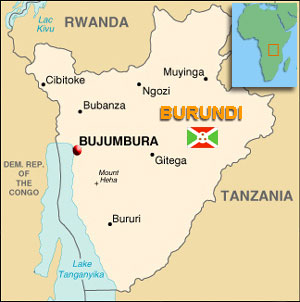
Signs of hope for Burundi

A lot is happening in Burundi these days. At least, recent events are offering some respite from the daily grind of poverty, joblessness, mind-numbing hunger, the pageantry of inept and paranoid politicians, a muzzled press... the list of untold joys goes on.

On the political front, an unexpected truce was signed this morning in Dar es Salaam between the government and the last remaining rebel group, the Forces de liberation nationales or FNL. Brokered negotiations have often looked too tenuous to ever succeed, and with arrests and detentions of suspected 'coup plotters' and FNL sympathizers dramatically increasing in recent months, it seemed clear that the FNL was better off continuing its struggle than surrendering to a government that has lost all popular credibility since winning national elections in August 2005. All the new government's promises of restored security, free education for Burundi's children, a reinvigorated economy and good relations with international donors, particularly the IMF and the World Bank--not one of these has been realized.

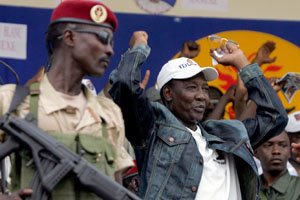
Former President Ndayizeye was
arrested on allegations of a recent
coup plot
Inside the ruling party, the CNDD-FDD--which portrays itself as a popular movement addressing the needs of the poor--fissures of discontent are beginning to show, hopefully resulting in better governance for Burundians. On Monday, in a clear vote of no-confidence that initially frightened then emboldened my Burundian colleagues, Vice-President Alice Nzomukunda resigned over corruption and human rights abuses that she claimed are hampering the nation's progress. The move was initially worrisome because of the 'sky is falling' reactions it triggered in this nation of hardened political skeptics. After the dust settled, however, political commentators and commoners alike were expressing support for the resignation as the first official recognition of the administration's illegitimacy.

Nzomukunda summarized her decision:

"My decision was motivated by numerous political problems which Burundian people are undergoing - problems of security, of not respecting the law, the management of state finances and of human rights laws which are violated. The country was on a good path to overcome all these problems, but corruption and economic embezzlement are undermining it," she said.

How the country is crumbling

I'm presently working here on child rights violations committed by the government, its various bodies--particularly its forces of order--and by insurgent groups. The sheer quantity of documented violations boggles the mind, and are enough to declare the prospect of childhood in Burundi a lethal undertaking. If the man in blue isnt raping or killing the little folk, they're dying from diahrrea or a fever for lack of basic health care.

Independent experts appear to agree that Burundi is a tragic place. The Happy Planet Index, published by the New Economics Foundation, an economics thinktank in the UK, recently rated Burundi 176 out of 178 of the world's (un)happiest countries. Zimbabwe and Swaziland took the last two spots.

Yet the country is ravaged in seemingly countless other ways, many of which are undocumented by the national press, local human rights bodies or their international equivalents. This week, however, Human Rights Watch and the Burundian Association pour la Protection des Droits Humains et des Personnes Détenues (APRODH) released a 75-page report, “A High Price To Pay: The Detention of Poor Patients in Hospitals,” documenting how Burundian hospitals detain hundreds of indigent patients, sometimes in inhumane conditions.

Many of those detained are women giving birth who unexpectedly needed caesarian deliveries. In some cases, hospital authorities refused further medical care to those who could not pay their bills and forced them to vacate their beds for wealthier incoming patients. For an excellent slideshow of conditions in Burundi's abysmal health system, where indigent patients are detained until their accounts are settled, click here.

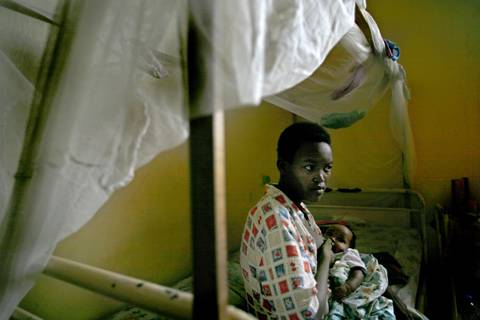
A young mother and her newborn baby, detained at Prince Louis Rwagasore Clinic in Bujumbura following a caesarean section.
© 2006 Jehad Nga

Friday, September 01, 2006

Burundi: False coup claims will extend conflict

Burundi's newly minted leaders celebrated their first anniversary in power last week here in Bujumbura with long-winded speeches at a reception for the diplomatic community. Despite clear blue skies and warm breezes off Lake Tanganyika, there was little to celebrate. With the harsh return of political intolerance and repression in recent weeks, Burundians again face an uncertain future despite a near end of over a decade of vicious civil war.

The East African reported last week that International Crisis Group (ICG) officials had called for Pierre Nkurunziza's government to produce evidence for the alleged coup plot that has resulted in the detention and torture of some of the most powerful politicians in the country. The government is saying nothing, while it is busy intimidating and detaining its critics. Hundreds of suspected FNL collaborators (the remaining rebel group) including children as young as 12 years old, have been arrested and paraded publicly at a local stadium. Many are still detained and reports of torture from human rights groups allowed to visit their prison cells are surfacing in the local media.

Days ago, the acting Special Representative of the UN Secretary General, in country for over five years, was called upon to leave Burundi by the government, who gave no public reason for the demand. Burundi's leaders are clearly sore over the UN's recent questioning of the alleged coup plot and the government's crackdown on critics and adversaries.

In the present climate, however, it is certain that regional mediation efforts, particularly by South Africa, to broker a government deal with the FNL will go nowhere. Why would they want to surrender now when leaders from every other former rebel group are being rounded up, arrested and tortured? As one Burundian friend told me: "Former friends make the worst enemies." Peace talks with the FNL in Dar es Salaam broke down in July, the alleged coup plot was declared "foiled" on July 31, and the arrest of supposed coup plotters and FNL sympathizers began shortly thereafter. Many of those initially arrested were involved in FNL peace talks in Dar the month before. Rabid paranoia can eat up the minds of the craftiest former rebels, it seems.

As a backdrop to all this, the UN peacekeeping mission in Burundi (ONUB) is scheduled to withdraw in December 06 but with the FNL continuing to recruit youth to expand its troop numbers and continue attacks on government and civilian targets, Burundi may not be ready to return to its own devices.

Tuesday, August 22, 2006

Saving face and letting blood in Darfur

In an excellent editorial by, I'm assuming, Sebastian Mallaby in this morning's Washington Post, the obstacles facing the much debated and awaited UN re-hatting of AU peacekeepers in Darfur are laid bare. People unfamiliar with the internal politics and divergent loyalties of Security Council Member states tend to blame the Darfur tragedy on 'Western inaction' or 'Khartoum intransigency'. Both are true, but amount to blaming today's weather on 'the weather' -- a finer tautology could not be found.

The resulting absence of a common front of decisive action on problems like Darfur or Rwanda is not justifiably glossed as 'the failure of the UN', as many would have it. It is simply the working reality of multilateral bodies where state interests dominate the agenda exactly as they do in the world of bilateral interaction between sovereign states. States act the same way alone as when they are in a team huddle; that is, they protect themselves and their friends of the moment. If we want UNSC member states to act differently, i.e., with greater common concern for problems like Darfur, someone needs to invent an entirely new basis on which states interact. Can the sheer force of human will stop dogs from randomly humping one another at the park? I think not; it is their nature.

UNSC Member states often have competing agendas, particularly when their interests converge with those of the offending government who is the subject of a pending Resolution, in this case Khartoum. China's oil interests in Sudan of course affect its position in deference to Sudan's wishes, as do the votes of other Arab countries, generally loathe to oppose publicly the actions, however murderous, of fellow Arab governments. Mallaby lays all this out clearly and definitively in his editorial. Sub-saharan African governments are often equally guilty of protecting their own, making the work of the AU all the more complex in any context, not just Darfur.

But he reserves his most lucid vituperation for President Bashir of Sudan, and the consistently arbitrary logic deployed to oppose international action on Darfur. UN peacekeepers are numerous across south Sudan to monitor the North-South peace agreement, but Bashir and other Arab nations oppose a UN intervention in Darfur, preferring an AU force that is far too weak and underfunded for the task. This is just face saving that facilitates the blood letting, and deserves all the scorn the world can muster. A full-on military intervention, in my opinion, would probably unleash another Somalia and perhaps an Iraq--a country with a far clearer record of Al-Quaeda connections than Iraq.

"Mr. Bashir has already accepted a 12,000-member U.N. force in Sudan's south, so he can't claim a principled objection to the presence of U.N. peacekeepers in his country. But he retains an unprincipled determination to keep the United Nations out of Darfur, even though the need for a peacekeeping force is clearer than ever.

The world needs to be clear what Mr. Bashir's position amounts to. As a result of his government's systematic destruction of African villages in Darfur, more than 2 million displaced people there depend on humanitarian relief, but mounting violence that claimed the lives of eight aid workers last month makes the delivery of relief extremely difficult. In these circumstances, barring the entry of peacekeepers is to condemn thousands of displaced civilians to starvation. It is to continue the policy of genocide that has marked this crisis from the outset."
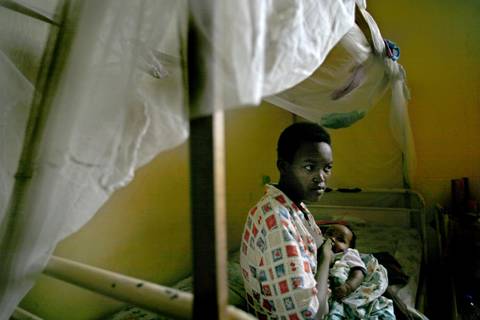
African Union forces will be definitively broke by end September, and no nation is stepping forward to bankroll them further, as has happened at previous junctures of economic crisis for the few troops spread across Darfur.

Whether the pending UNSC Resolution is passed, and what it will stipulate (20,000 UN peacekeepers are the main menu item), will testify to the existence of a unified front on Sudan. Should it land flat and go nowhere, civilian survivors in Darfur can begin digging their own graves.

Child Soldiers in Burundi

Burundi is one of the countries specifically targeted by UN Security Council Resolution 1612 banning the recruitment and use of child soldiers. The country's long history of internal conflict saw at one point as many as 19 different factions, most of them armed and militarily engaged. It has significantly pacified since national elections in 2005 even though one rebel group refuses to disarm/disband (FNL). Shelling onto Bujumbura, the capital, remains periodic and UN peacekeepers are deployed across the country.

As all armed factions used child soldiers throughout the war, including government forces with their infamous Tutsi paramilitary youth groups, the Gardiens de la Paix, these minors are now 'without a cause' and most definitely without gainful employment, education, etc. Armed criminality is widespread, making Kalashnikov-brandishing the most popular 'income generating activity' among poor kids with previous military experience.

I am heading to Burundi today to gather evidence about the new government's progress on implementing Resolution 1612. The country has ratified all major child protection treaties of the last twenty years, but has been among the least effective in implementing them.

More to follow once I'm in country.

Tuesday, August 08, 2006

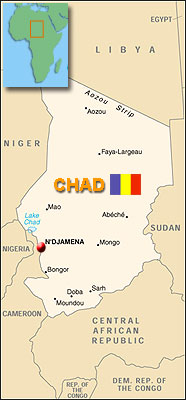
Chad-Sudan detente as attacks on aid workers and refugees escalate

Sudanese President Omar al-Bashir made a surprise visit to N'Djamena, the Chadian capital yesterday, to celebrate Chadian President Idriss Deby's inauguration into a third presidential term. Al-Bashir and Deby have accused each other of supporting rebel movements in their countries.
[Al-Bashir]
Chad broke diplomatic relations with Sudan on April 15 after anti-government rebels allegedly based in Sudan and Central African Republic launched a deadly attack on the Chadian capital N'djamena. Sudan has denied Chad's claims that it supports the rebels in its territory and said Chad is sponsoring rebel groups aligned with Deby's ethnic group, the Zaghawa, which have been fighting the Sudanese army. On July 26 Chad and Sudan signed an agreement in N'djamena aimed at normalising relations, in a reunion orchestrated by Libyan leader Moamer Kadhafi (see his website).

Chad and Sudan, locked in mutual acrimony in recent months, on Tuesday decided to "put a definitive end to their differences" and immediately normalise relations, broken off in April. Deby and al-Bashir promised a "solemn commitment to put a definitive end to their differences by immediately normalising diplomatic and economic relations", according to a statement from the Chadian government after a mini-summit between the two leaders.

The meeting took place in N'Djamena as Deby, 54, was reinstated in his consecutive presidential mandate after being reelected on May 3. The men met in Kadhafi's tent after Deby's swearing-in ceremony. The elections that were dismissed by the opposition as rigged.

[Deby celebrates victory]

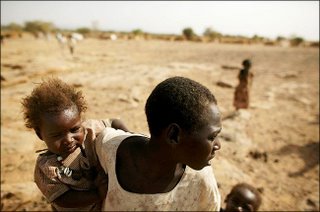
The detente comes as the Darfur crisis on both sides of the Chad-Sudan border continues to deteriorate. On the Sudan side, eight Sudanese aid workers were killed in July as Khartoum signed a peace agreement with the Sudanese Liberation Army (SLA). In eastern Chad, where over 213,000 Darfuri refugees are camped, attacks continue by Janjawid militants against refugees and aid workers. The instability makes the continued provision of aid extremely precarious for foreign aid workers, whose presence ensures a degree of protection for the refugees, who are the primary target. UNHCR and other aid agencies have denounced these attacks, but Deby's national army has no control over this part of the country.

[Bleak life in eastern Chad]

Friday, August 04, 2006

Arms Across Central Africa

A July report by the Geneva-based Small Arms Survey (SAS) on the understudied Central African Republic (CAR) reiterates the fragile volatility of this land-locked, often overlooked nation. Despite having hosted four international peacekeeping missions in the last ten years, the civil wars and humanitarian disasters in neighboring countries (Chad, Sudan, Niger, DR Congo) routinely make headlines while CAR remains an unknown quantity to the outside world. My personal theory, not entirely facetious, is that the country needs a more memorable name, one that sounds less like an airport parking lot.

The July SAS report summarizes four years of research indicating failure by the central government to regulate weapons among civilians, and how this has led to a massive influx of arms into large parts of the country. The resulting inability of government security forces to maintain law and order is increasingly evident across the country, with large population displacement as civilians (women and children predominantly) flee waves of armed criminality by roving gangs. Populations of CAR refugees in the DRC, Sudan and southern Chad have grown into the tens of thousands over the last couple of years.

Besides addressing the usual causes and effects of uncontrolled arms proliferation, the spread of arms-related violence and its impact on social development and economic indicators, the report examines the ways in which international neglect of one African context (CAR, in this case) can fuel or trigger conflict in the wider region: Chad, Sudan and DR Congo all have experienced a domino effect from CAR's simmering instability. The government's assertion that 50,000 small arms are circulating beyond its control, for example, is shown to be grossly underestimated; its capacity to regulate weapons among civilians non-existent. Past disarmament efforts have been ineffective, as SAS argues in a chapter in its 2005 yearbook.

In November 2005 I visited the southern Chadian town of Gore where over 30,000 refugees had fled the violence in northern CAR. The UN refugee body (UNHCR) had set up makeshift camps and was draining tight resources from its activities in Eastern Chad for the 200,000+ Darfuri refugees settled there. Few aid agencies apart from UNHCR could spare the resources to respond to the refugee influx, a shortfall aggravated by the lack of media interest in the story.


Ass, grass or goats, nobody rides for free: bus en route for Bangui
(Photographer: Paul Dymond)


Small Arms Survey publishes periodic reports, such as this one, but its main mission is the massive yearbook, microscopically researched and often amazingly well-written. These annual reviews are on a par with similar annual tomes documenting, for instance, the state of global human rights (Human Rights Watch), or the state of landmine pollution and/or destruction (Landmine Monitor).

I've long held SAS in high regard, well before they published my report on the impact of armed violence on women's livelihoods and sexual health in Burundi. The indispensibility of the group lies in its capacity to generate, year after year, evidence documenting the countless ways that small arms proliferation impedes social and economic development in poor countries. The obvious irony that these weapons often originate in the same industrialized countries whose development aid budgets ostensibly save lives in places like CAR, is borne out through careful documentation.

No other think tank establishes with similar objectivity the causal link between arms transfers and underdevelopment in countries with notoriously dysunctional governance--a causality that needs to be shouted from the rooftops. The absurd logic of simultaneous arms transfers and foreign aid to poor nations by rich ones is so fundamentally wrong-headed it defies comprehension. Perhaps, in a daydream world, some invisible hand is guiding these inputs, and good will result. <Audience laughter cue here.>

Like most Africans I meet in my work, I believe that western donors, particularly the US, have no coherent strategy to deal with Africa, hence the competing forms of intervention and their tendency to mutually undermine one another. No one in the donor governments is willing to break some eggs, bust a few egos, and forcefully weave the various tentacles of our schizoid African policy into a coherent strategy. Why? Because at some reptilian level of the psyche, we are afraid of Africa ever becoming, God forbid, functional.

Contrary to many Africans and Americans, however, I do believe that the UN, bless its battered soul, does have Africa's interests at heart. Unfortunately, its meagre resources and capacity cannot stem the tides of (1) a venal political class in many of Africa's poorest countries and (2) the aid agendas of donor nations wiltering before the iron fist of their economic/power interests, which rarely match those of the UN.

Thursday, August 03, 2006

No shame for the shameless

As most of you know, I've been working with child soldiers in the DR Congo most of this year. My focus has been on evaluating programs run by the usual aid agencies: UNICEF, Save the Children, International Rescue Committee, the Red Cross network, and a host of smaller Congolese groups. These actors are funded by tax revenues and private donations from people in developed countries, so directly or indirectly, you and I are paying for them. Such evaluations provide accountability to donors that they're getting what they paid for. Anyone who says international aid is unaccountable is simply uninformed.

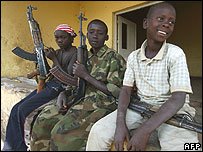
In previous postings I've explored some of the problems posed by the child soldier phenomenon, but I tend to take for granted the big picture dilemma that this sad group of victims cum perpetrators poses to our world. It's worth mentioning here: What to do when previously accepted morals and norms prohibiting certain forms of behavior (universally shared taboos, if you like) cease to enforce the limits of barbarism? Capturing and re-programming underage youth to slaughter enemy combatants and innocents is one such taboo that no longer exists in 37 of 55 recently ended or ongoing conflicts.

Efforts to halt child soldiering are gaining little ground. Are limits in wartime entirely obsolete; is everything now permitted? More pointedly, why are contemporary forms of shaming (i.e., activists agitating over genocide in Darfur; publicity campaigns to stop the use of child soldiers) so limited in their impact, and yet a whiff of 'yellowcake' in Niger is enough to trigger a trillion dollar invasion of a ghetto autocrat with no link to Al-Quaeda?

The question strikes deep at the heart of political possibility and its underbelly: that the human condition is essentially immutable. For what it's worth, there is a definite dialectic of moral outrage and political action at work in our world today. Activists shout, politicians and companies react, things appear to change. Elimination of child labor use by Nike and company comes to mind.

But what if you live in a neighborhood where people with conscience fear to tread? Well, I work in those places for a living, and I see what happens to activists. Local ones get imprisoned or 'disappeared' and foreign ones get ignored by politicians who are beyond influence and above the law. So why is nothing done about these miscreants, who have far more blood on their hands than Saddam ever did? I still experience mind-numbing stupefaction every time I recall that a delusional dingdong like Saddam got a visit from Uncle Sam and his heavies, while scores of real warlords who've wrecked countless lives and entire countries continue to dance, sing and run for political office, as in Congo, Liberia, Sierra Leone, etc. Where are our priorities?

PW Singer, author of the book pictured above (Children at War), raises this question in his course of discussion and analysis of the so-called 'child soldier doctrine'. Singer offers a convincing account of the use and limits of advocacy groups and UN Security Council Resolutions prohibiting the use of child soldiers, but anyone as frustrated as I am with the state of the world already knows these failings in painful detail. Obviously, a warlord controlling thousands of child soldiers is operating in no known moral universe, so the indignation of his compatriots or the threat of a war crimes indictment, for instance, have no impact. The explosion of child soldiers boils down to economic interests and the instantaneous force multiplication provided by hundreds of armed pre-teens. In other words, child soldiers have made getting rich quick in an already lawless environment easier than ever before. In countries like the DRC where anarchy is enormously lucrative, nothing appears capable of stopping this trend.

I most appreciated Singer's historical account of how the child soldier doctrine came about in the first place. He also relates the malignancy of metastasized statelessness where groups using child soldiers become havens for global terrorism. A case in point is Charles Taylor's Liberia exchanging its gold and diamonds with Al Qaeda operatives who needed to 'go light' and drop millions in cash.

Child soldiering. Definitely the world's most unrecognized form of child abuse.

"I feel so bad about the things that I did. It disturbs me so much that I inflicted death on other people. When I go home I must do some traditional rites because I have killed. I must perform these rites and cleanse myself. I still dream about the boy from my village that I killed. I see him in my dreams, and he is talking to me, saying I killed him for nothing, and I am crying." A 16-year-old girl after demobilization from an armed group (Source: U.S. State Dept. TIP Report 2005).

Wednesday, August 02, 2006

DRC: The Wolf Cries 'Wolf'

If Congo's tenuous order does unravel into widespread violence in the wake of national elections last Sunday, the resulting strife will no doubt be due to the uncivil rumblings of presidential candidates incapable of accepting 'the voice of the people'.

Azarias Ruberwa, leader of RCD-Goma and one of four vice-presidents within Congo's transitional government, was the first to cry foul after voting booths closed on Monday. A lawyer and evangelical preacher with significant financial support from southern US churches, Ruberwa has never impressed me as a man of political vision or moral clarity.

So for a wolf such as Ruberwa to cry 'wolf' is an obvious attempt to re-assert his political relevance at the moment when history may sweep him off the stage. Normally the irresponsibility of such accusations without evidence would implicate no one but himself, but with Congolese voters being as frustrated as they are, it could set off waves of post-election violence. Meanwhile, Kabila and Bemba are each declaring victory while voters themselves wait impatiently for official results to be made public.

Indeed, Ruberwa's accusations are the last gasp of a politician facing his imminent obsolescence. Representing a complicated political agenda given RCD-G's connections to Rwanda, Congo's most recent armed invader, Ruberwa belongs to an unloved and targeted ethnic minority in the eastern provinces, the Congolese Tutsis. And victim though he may be, Ruberwa failed to bring peace and security to the East during his tenure as vice president in transitional government. This failure has been a thorn in his side, and a source of continued frustration for his supporters, His party is extremely unpopular throughout the country as a result of its alliance with Rwanda during the war.

RCD-G led a brutal regime throughout the war (1998-2003) in which civilians were regularly targeted as suspected collaborators with 'the enemy'. War crimes in the form of civilian massacres directed by its core military leaders have been documented by Human Rights Watch, yet these men walk free. Their reign of terror and fear crippled the local economy by paralyzing movement within their territory, which constituted more than a third of the country at the time. I spent hours, sometimes days, in front of RCD officials and soldiers at borders, airports and road checkpoints, waiting out their demands for bribes and accusations of espionage. I never landed in jail, but always came away from RCD encounters a few pounds lighter, once they'd 'relieved' me of any bags, documents or communications equipment I was traveling with. Ruberwa and his gang of knuckle-dragging thugs hold a special place in my heart.

Congo also happens to be the country with one of the highest numbers of child soldiers in the recent history of global armed conflict, with estimates exceeding 30,000 (Myanmar and Sudan are higher). And although all three primary contenders for the presidency (Kabila, Ruberwa and Bemba) once led armies whose core combatants were children, RCD-G under Ruberwa were perhaps the most insidious in their practice of abducting and forcing children to the frontlines as cannon-fodder. On two separate occasions (2001 and 2003), formal agreements were signed with UNICEF and other child protection actors stipulating that up to 6000 child soldiers would be immediately released. In neither instance were these engagements respected.

In the end, how the candidates react to the election results is more important than the results themselves. What matters most, of course, is what changes it brings for the average citizen. As one analyst notes, 'The election will be a success if it gives a woman farmer the strength to refuse to give half her daily produce to a man with a gun,' (The Guardian, "Warlords in the Wings.")

Crying wolf now, when Congo needs a show of national unity and fortitude, is just another manifestation of the divisive cowardice of the country's political class.