Thursday, March 23, 2006

DR Congo: An uncanny sense of smell...

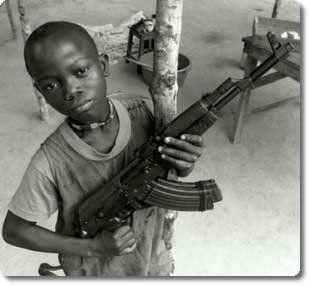
...is had by the average canine. During my recent trip to DR Congo, many of the former child soldiers I met--dogs of war in their own right--had caught whiff of certain unseemlies issuing from aid efforts designed to help them escape armed groups and reclaim their civilian childhood. By the time I met them, they had been disarmed, released and were on their way back to the village. Things were fairly rosy compared to their former lives as armed packmules and cannon fodder. Now naked without their guns, they were still a surly lot, clearly used to lording over anyone in their vicinity. Even without their weapons, their wolf-pack behavior continued. I watched the group dynamic as they banded together against an outsider or perceived threat. Alternately, when the coast was clear, they would snarl and turn on each other: teasing, abusing, dominating or being dominated. A de-militarized mind was still a long way off.

In my interactions with them, we spoke not through a translator but in Lingala, which they seemed to enjoy. Once the initial raucous of my visit had subsided and the group became more reflective, often they would raise issues that surprised me with their prescience and directness. Indeed I heard one particular question repeated in nearly every 'transit center' or 'demobilization camp' I visited. It so happens that this issue is precisely that raised by a former World Bank economist in his recent book, The White Man's Burden.

Gaping holes and naked 'Big Men'

I was in the DRC to evaluate efforts to release and rehabilitate child soldiers over the last two years, efforts that cost the international community more than $20 million. By and large, the program has gone well with one glaring exception, a shortcoming not lost on the child soldiers I met--resulting in that uncanny sense of smell referred to above. Why did we westerners, they wanted to know, confide our foreign aid dollars to their politicians and administrators when everyone knew the money would never reach its intended destination? Why didn't foreigners manage the aid money directly, instead of giving it over to the government where it proved ineffective or simply evaporated?

[children in DRC demob camps] Programs to disarm, demobilize and reintegrate child soldiers (the DDR process) are more than a military and security measure in the post-conflict stabilization process of nations such as the DR Congo. More importantly, the programs serve to reconnect former child soldiers with their families and communities, to rehabilitate individual lives and to reweave the social fabric as positive foundations are laid for the future. To succeed, each of the three phases of child DDR must be executed in a timely and coordinated fashion. As in other African countries where large child DDR programs have been realized, the greatest obstacles to lasting achievements in the DRC lie beyond the scope of the implementing agencies themselves. These obstacles include ongoing conflict and political uncertainty, a deeply fractured socio-cultural sphere and a barren national economy. This scenario is further complicated by a thoroughly destroyed national infrastructure.
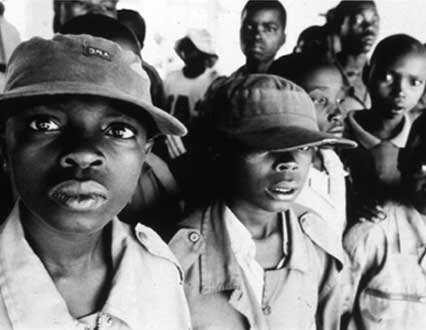
Faced with the above challenges in all seven provinces of operation, the six aid agencies hired to implement the program have by and large managed to provide adequate care and support to children in transit between point of release and their home communities. The third and final phase of the process—projects aimed at the social and economic reintegration of the child within his or her home community—has yet to commence in earnest, due to operational delays and planning problems.[1] Providing a complete reintegration package to the remaining caseload of children before international financing dries up in June 2006 will be impossible. This is a failure, to be sure, but one that can be fixed with more money.

A more substantial failure --raised by the children themselves-- casts a long shadow over the whole process, and augurs poorly for international efforts to combine foreign aid programming with "nation-building" initiatives. In the DRC, the international community was funding child DDR programs (implemented by the usual heavy hitters: UNICEF, Save the Children, etc) while simultaneously funding the creation of a national ministry to supervise and coordinate the DDR process for all ex-combatants, a $200 million dollar venture.

Performance by this government ministry, the Commission Nationale de DDR, or CONADER, has been sub-standard. Lacking are a proactive analysis of available capacities and resources, an ability to anticipate and identify gaps and weaknesses in agency programming, and to harness the energies of disparate actors towards a common work plan, one that is subject to agreed performance indicators and criteria. Our team of evaluators found no evidence that CONADER is capable of performing the above tasks, nor did it demonstrate a willingness to learn from other qualified actors (UNICEF, specifically) in order to perform optimally. This was the gaping hole in the national DDR program for children, the emperor without clothes, for which the children themselves were demanding an explanation.

Such incapacity is the inevitable result when any government ministry, Congolese or American, is run by a cherry-picked network of 'friends of friends' whose opaque selection criteria boil down to tribal connections and clientelism. It is this form of corruption that is destroying Congolese hopes for a true meritocracy in the post-war public and private sectors. None of the CONADER staff I met had the faintest idea how to conduct so huge an operation (DDR for adults and children combined) with the appropriate planning, administrative systems and structures of accountability. Yet they were given their jobs anyway, because they were 'Big Men' and had the right connections.

Why work with mental invalids and common crooks?

"Because we have to," comes the honest answer. We live in a post-colonial world. The international community must deal with developing countries, even countries like Somalia without recognized governments, as sovereign nations. USAID or the World Bank does not hire and fire national ministers in the Congo. Also, the foreign aid business is not the private sector. We can't just 'cut our losses' and walk away from our investment, as multi-nationals commonly do. We can withold aid monies, or attach strings, but is this what emergency relief funding should be -- a carrot and stick for better governance? I dont think so, but I'm in the minority.

What upsets me is that national government structures created by the international community to deal with a given post conflict problem -- such as DDR and CONADER -- are held to a different professional standard than the international aid agencies funded to achieve specific results and who are subject to the standard regulatory norms.

This exceptionalism is wrong for lots of reasons. Primarily, it is a form of paternalism, in that we treat them like children (itself neo-colonial) when we dont hold them to the same standards as everyone else, ourselves foremost. Secondly, it amounts to complicity with the malaise of much African government: tribalism, clientelism and absence of meritocracy.

My answer to the child soldiers' question about money going to CONADER was this: they are your leaders, they are accountable to you alone, and you have national elections coming up in a matter of months. Are you going to continue to look to the outside world to solve your internal problems, and to blame the outside world when Congo remains a mess? What has that achieved, besides excluding you even further from responsibility for the country's woes? (Congolese love to blame their problems on outsiders, and I love to accuse them of avoiding any responsibility for their tragedy. We get along famously this way.)

A lot of silent floor-staring always followed these remarks. It seemed no one had any idea what I was talking about. In Congo, they told me, the hand that gives is always above the hand that receives--this will never change. Translation: democratic elections are a charade. Money talks, bullshit walks, and so goes the country. He who makes the gold makes the rules. Our leaders will never listen to us, only to you, the international community, as long as you continue to hold the purse strings.

Let's lynch the landlord!

A recent book from William Easterly, The White Man’s Burden, addresses this problem from a similar angle. Easterly is the former World Bank economist who jumped ship (landing unscathed in an Ivory Tower – NYU) after publishing his 2001 assault, The Elusive Quest for Growth, on the folly of western institutions trying to jump-start economic growth in the developing world. Africa is the primary exhibit in the litany of failures that follows.

My first reaction was the brain thud of 'how typical': all too often the bashers of foreign aid use 'hopeless Africa' as their sole piece of evidence. What about all the foreign aid that has helped other parts of the globe? For instance, World Bank economists consider India and China to be two of the greatest foreign aid success stories. What of the Vietnams or Chiles (both socialist, but still helped considerably by a largely non-ideological World Bank), or other success stories of foreign aid?

I'm not particularly partial to the Bank. It's just that a more truthful book would not bash (exclusively) the West's efforts to help people in hell, but would document the reasons why those people are in hell in the first place. Congolese child soldiers were not denying the fact that the primary problem lay with their political class; they just wanted international donors to carry a bigger stick. But international donors are not in the business of busting kneecaps or playing global cop. Alas, that would be too easy, and I often wish they would. But to blame Darfur or the human tragedy of Congo on the international community (donors, the UN, aid agencies, etc.) only adds to the obfuscation while fomenting a dubious rationale for isolationism and disengagement.[2]

[Chinese peacekeepers heading
to the DRC]
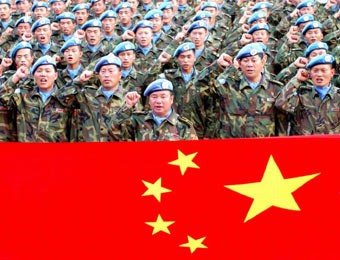
Unsurprisingly, perhaps, the country making the greatest inroads into African economic development and resource extraction, the People's Republic of China, does not consider itself a member of the 'international community' regarding African affairs. 'Bullied and manipulated' by the West, China sees in Africa a trading partner and fellow developing country. [see report]. Unlike the West, it attaches no strings or conditions regarding 'good
governance' or democratic reform to its bilateral assistance. No doubt this is an attractive alternative for African governments, but one of some consteration to the western aid community, who recognize its potential to take the bite out of Western efforts to democratize and bring accountability to African governments -- the 'nation-building' experiment of CONADER criticized above.

So what did I recommend should be done about CONADER in my report to donors? The impossible: burn the house down and hire some serious candidates. It may never happen, but at least it made some people squirm uncomfortably in the board room.


[1] To wit, 9749 children are reported as presently engaged in social and economic reintegration activities, only 42% of those demobilized and reunified thus far (or 22% of the overall number of 43,903 to benefit from the child DDR program).
[2] For the record, while I'm venting, Congo's tragedy is not the fault of the World Bank, the Rwandans, the US, or even colonialism. Wherever there are victims, people automatically start to fantasize about the cause and effect of some limitless power. The more humble reality, as Iraq shows flawlessly, is that no foreign institution or occupying force or colonial era is so powerful as to condemn an entire country to purgatory for the last 40 years.

Sunday, February 19, 2006

Child Soldiers in North Katanga, DRC


Sunset over Lake Tanganyika at Kalemie, in North Katanga. Under Mobutu, this province's mineral resources and mining industry used to generate over 50% of the country's GNP. Now it festers in a state of aggrieved destitution while its political and sundry military leaders engage in willful self-mutilation. Kalemie itself, suprisingly, is calm and I walk around at night without fear. But the province is at least 2-3 years behind the rest of the country in terms of the peace process; disarmament and demobilization of military factions has barely begun. An excellent overview of the dysfunction in this particular corner of the country can be found here.

I am here with a team of evaluators to assess the impact of a number of internationally-funded projects to secure the release of child soldiers from an array of military groups and to return them to their families and communities. If the projects are successful, the children will return with the means and mental wherewithall to resist the pressures of re-recruitment, as combat continues and children make the best soldiers--so the logic runs--because they rarely disobey or run away, they dont require a salary and their minds are perfectly malleable, unlike adults and older adolescents.

Such evaluations are always exhausting, and this one is no exception. Today is Sunday but we have much planned: a motorcycle trip out to a village where a number of children have been reunited with their families after being released by some of military groups still active around here. We tried to get there yesterday by jeep but the mud was endless and we had to return to town. Instead we visited a local transit center for recently released children, who await reunification with their families, provided these latter can be found. The boys we met there were mostly under ten. Prepubescent kids serve mostly ritualistic roles and rarely bear arms. Those we met were used to transport the fetishes and various magic effects around for Mai Mai militias (who believe, for ex., that their bodies are bullet proof). Pre-pubescent girls are made to wash the naked bodies of the adult combatants with magic potions before and after battle. Many such girls are daughters of the Mai Mai officers and commanders, so any prospect of securing their release from military servitude is scant.

Mayi Mayi and soldiers dance together
at Dubie, Katanga. Credit: UNICEF

Older kids serve as spies, porters or are sent to the front as cannon fodder. By the time we meet them in these transit centers they are often traumatized with extreme ADD. They are aggressive at first, sometimes fighting amongst themselves or banding together to smash windows and break furniture at the transit center. In some centers we've visited, children have taken their caretakers hostage, demanding money, goods or immediate release. Rape of younger boys by older ones is sometimes reported by staff; children re-enact the brutal heirarchies of their former military existence because it is more familiar to them than civilian or family life.

While aid workers trace and contact the children's families to prepare the process of reunification, the hard work of 'demilitarizing' their minds gets underway. Once found, preparing the family and community to accept the child's return is compounded by the difficulty of finding the kids something constructive to do that might generate a meagre income -- largely impossible in war ravaged areas where there is no local economy. There is rarely money in circulation, nor is there anything to buy or sell. Bartering for basic foodstuffs is the norm in rural areas. Like everywhere else in the country, there are few medical facilities, drugs or trained staff, so if a child gets diahrrea or a fever s/he will likely die.

In such an economic desert, once released from the militias and back in their villages, former child soldiers quickly get restless and frustrated. Large numbers voluntarily return to military life for want of something to do and the possibility of partaking in the spoils of war, usually little more than ransacking the neighbors, who have nothing anyway.

When I meet these kids I often think of my nephew, who is their age. They enjoy speaking with a foreigner in Lingala, the language used by many military groups, even here in Swahili country. But their minds are in a very different place: partly fried, partly deformed by combat and the 'Lord of the Flies' reality that has been theirs for years, in some cases. In others I can sense an inner child still present but lost or clouded by memories and military conditioning. Many have the incongruous air of adult combatants with their unpredictable moods that swerve erratically between vacant, mile-long stares to hostile agitation, triggered by the sound of a voice or the sight of a foreigner.

The programs we are here to evaluate are confronted with enormous challenges, and their chances of sustainable succes are slim due to factors beyond their control -- nothing in this environment is conducive to normal childhood, or normal life for that matter. We have about 2 weeks left and many many more projects to visit, scattered all over the country, wherever militias, rebel factions or the government army itself have been using child soldiers.

Thursday, January 19, 2006

Inept governance, Congo's constant companion

I was in Congo much of November 2005 to evaluate the success of various aid projects to 'support the political transition' at the community level. I will return this week to begin looking at international efforts to rehabilitate former child soldiers, or 'kadogos' as they're called in Congo. Congo's national elections will be soon upon us, after three years of largely unsatisfactory transitional government. What follows are some thoughts on how aid projects funded by the international community can engage this negative dynamic in support of a more promising transition, credible national elections in April and a serious start at legitimate governance for the victorious party.

In sum, disengagement and the self-interest of Congo’s political elites, combined with their mutual mistrust, has resulted in a dysfunctional transition; this political dysfunction is also a root cause of Congo’s material and social destitution. Nor is there a sufficiently robust civil society to act as a safeguard against excessive predation by the elites or even to mediate relations between the masses andgovernment officials. Congo’s ragtag civil society of NGOs and media outlets serves rather as means of economic survival for its adherents, rather than a tool to hold the state accountable.

In the shadow of Mobutu

Struggling to transition from dictatorship to democracy since its return to multiparty politics in April 1990 under Mobutu, Congo’s path to democracy remains extremely rocky. The basic democratic requirements of minimum state capacity, order, and disincentives to violence are totally absent. This is compounded by citizens’ distrust of political actors and manifest distrust among the actors themselves.

The Inter-Congolese Dialogue resulted in the adoption of a Transition Constitution and of the “Global and All-Inclusive Agreement on the Transition in the Democratic Republic of Congo,” ratified in April 2003. These documents set up the principles and objectives of Congo’s transition, including reunification, pacification, reconstruction, restoration of territorial integrity and of state authority over this territory, the creation of an integrated army, and the organization of elections. This resulted in the formation in June 2003 of a Congolese power-sharing government composed of members designated by the delegations attending the Dialogue. The new government had a “1 + 4” formula at its core which reserved the presidency for Joseph Kabila (son of late Laurent-Désiré Kabila, assassinated in January 2001) and appointed four vice-presidents.[1]

[Kabila pere: Gone the way of Che]

Together with a 40-strong executive, a parliament of 620 appointed members, and several “institutions of support to democracy” (the Independent Electoral Commission, High Authority of the Media, Truth and Reconciliation Commission, Ethics and Anti-Corruption Commission, and Human Rights National Observatory), the new government was charged with organizing the transition to democracy over a two-year period. Of particular importance also was the establishment of the International Committee for Accompaniment of the Transition (CIAT), composed of members of the UN Security Council, international donors, and some African governments, which was charged with protecting transition institutions and arbitrating disputes. The government was appointed on June 30, 2003, inaugurating a two-year transition period which included among other things: the adoption of a draft constitution; a law on the principles of nationality; an electoral law; registration of voters; a referendum on the draft constitution; and the election of a parliament and president.

Despite the presence of over 16,000 UN peacekeepers in country, ongoing violence across the eastern provinces underscores the fragile state of the transition. Armed groups of disparate allegiance have failed to commit to the peace process. This insecurity limits the geographic reach of aid agencies into key areas of vulnerability and dire need. Continued conflict and transition dysfunction have meant that by early 2005, Congo’s transitional government had yet to pacify or extend its authority across its territory. As a result, national elections were delayed by six months, provoking violent outbursts and insecurity from a desperate and impatient population.

[UN peacekeepers in the East]
The Congolese transition has been characterized by a high level of institutional dysfunction and a paucity of achievements. Although the government, parliament and military hierarchy were installed by September 2003, most of the “support institutions to democracy” took much longer to become operational, in part because of the government’s failure to adopt the necessary legal texts. The quest for personal enrichment by members of the various transition institutions has triggered widespread reciprocal suspicion among them has made it all but impossible to establish functional cooperation among the different organs of the state.

Given the huge discrepancy between what international aid agencies can deliver and the capacity of the state to participate and contribute in the country's reconstruction, it is understandable that communities see no ‘transition dividend’ from their government. Indeed, there remains a strong sense among Congolese that the transition is controlled by outside forces, its outcome foretold and beyond their control. This non-credulity undermines popular engagement and ownership of the transition process. [In fairness, this suspicion is somewhat justified: the CIAT, national elections, Inter-Congolese Dialogue and Sun City, MONUC peacekeepers, and DDR agencies – all of this is funded and driven by foreign actors.] Further, the conviction that the West profits from Congo’s chaos (via mineral extraction and arms sales) is widespread. There is relatively little sense that Congolese elites are the primary enablers of this resource theft.

A difficult dilemma preoccupies many Congolese today, that between a recognized need for outside intervention for a successful transition, and the common belief that outsiders control Congo and profit from its dysfunction. The result is a legitimacy deficit regarding foreign donors or international agencies, as well as Congo’s political elites. During my recent evaluation trip, I heard a common refrain: “Why vote for any of our officials; what have they done to earn our vote?”

[Joseph Kabila: former kadogo]
Many aid agencies seem to assume that the transition will succeed and the State will pick up and resume the work of stabilizing the country and rehabilitating essential public services. Unfortunately, this is not likely to happen, and the Congolese know it. Because so many aid operations avoid the messy work of directly involving state officials and transition institutions in their relief activities, the problem is compounded. International aid subsitutes for the work of the state, and thus risks triggering a legitimation crisis for the state -- not necessarily a bad thing if it could lead to better governance. What it usually leads to are militant crackdowns and more brazen theft of public funds and resources by political elites.

In setting up and running their operations, very few aid agencies or bilateral relief efforts implicate government officials at the national or provincial levels. In so doing, aid groups step directly into the role of service provider, thereby allowing the transitional government to continue its infighting and introspection and to disengage from social service provision, including salaries for health and education workers. Ongoing neglect of the country’s basic needs fuels the popular sense of abandonment, thus furthering the government’s current legitimacy crisis in the eyes of citizens. Inclusion of local, provincial and national transition actors and institutions in community reconstruction work should be recognized as a core strategy for aid groups to advance and reinforce the transition.

One of the programs I was recently evaluating was of the 'community-focused reintegration' model, also used in Sierra Leone, Burundi and Liberia to re-weave the social fabric after a decade of mutual decimation, and to re-connect the population to the national political process. The CFR program I was visiting sought to support the political transition in DRC by strengthening participatory processes at the commumity level, in an effort to improve community self-reliance and self-determination. However, there was nothing for communities to work with. Dire poverty and a total absence of capital have spelled utter dependency for many rural communities. This was particularly true in Ituri , where conflict and displacement still prevent continuous farming. When enjoined to pull themselves up by their bootstraps, community members in Ituri responded: “We have no boots!” Moreover, the government’s incapacity to provide the bare minimum of services reinforces the sense of dependency on outside actors and foments discontent. Such frustrations are a potential source of post-election backlash, since the bouts of mass looting and vandalism over the last 15 years have been triggered by a similar sentiment and conditions.

[Kadogo: proud to serve]
The CFR program ‘opened minds’, or so many participants enthusiastically claimed. Political support and votes can no longer be bought, they told me; similarly, many youth claimed to be less susceptible to political manipulation and violence. When asked about national elections, they all responded: “What have these candidates done to earn our votes?” After nearly two years of this particular CFR program, worth millions of dollars, the behavior and instincts of the political class are unchanged; only voters have evolved. The common sentiment is that the poor are constantly subjected to bad governance, but are not given the means to change it. While this may constitute increased awareness of the political transition, it does not come with the desired component of popular empowerment.

Transition, yes - but where to?

Over all, inept governance by transition actors and ongoing violence in the East are the ‘weakest links’ of the transition. Despite an easily foreseeable prolongation of the transition period (elections particularly), the US-funded agency I was evaluating showed no apparent willingness to shift its timeframe and budget to accommodate the delayed elections--they are ending operations in March 2006. Bypassing opportunities to engage the various transition support institutions and ‘commissions’ created by government, this and similar aid agencies forfeit a valuable means of reinforcing the transition by working with the political class at national level. This appears to be due to a ‘grassroots bias’ in many community-based aid programs, for the weakest link in the transition is the political elites, not the communities or ex-combatants. Such opportunities were lost, I argued, because of an unexamined assumption in the program design that communities are somehow more central to a successful transition than the politicians themselves.

In Congo today, there is no substrate for development: no infrastructure, no managerial or administrative systems of any kind; nor is there any human capacity to implement such a management system, public or private, at local or national level. If the administrative and political classes lack these basic capacities and instincts, it is highly unlikely that communities themselves can manage basic investments (schools, information centers, etc.). The DRC government expects the international community, with its army of NGOs and aid agencies to develop the country. But community buy-in is a foreign ideal that is certainly not shared by government. The government does not care who provides the pump, the bridge, the school or how it gets there – just that it gets done. (It cannot organize or implement such projects on its own--this should be shameful but political elites could care less.) It is the governmental leaders, more than the people, who need new values and perspectives. While working with Congo’s inexperienced and self-serving political class may not be as easy to do as community mobilization and education at the grassroots, it should be part of a transition strategy in countries like the DRC.

On a very different note: the old Zaire/MPR flag is still my favorite, despite its association with tyranny and megalomania. What other national flag can boast a human appendage brandishing a flaming torch? Far more declarative than the usual combination of stars, swaths and stripes.


[1] One from the previous government (Yerodia Ndombasi), one from each of the main rebel groups (Jean-Pierre Bemba for the Mouvement de Libération du Congo—MLC and Azarias Ruberwa for the Rassemblement Congolais pour la Démocratie—RCD-Goma), and one from the unarmed political opposition (Z’Ahidi Ngoma). Long-time political figure, Etienne Tshisekedi, leader of UDPS (Union for Democracy and Social Progress) and former Prime Minister under Mobutu, was excluded.


Monday, January 16, 2006

Passing the bucks in Darfur

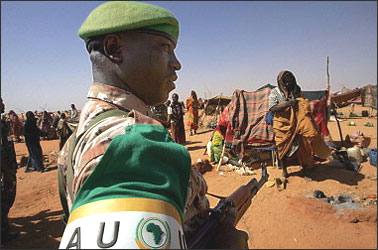
One of Africa's most important experiments--African troops providing security in African conflicts--looks slated for premature burial. The current African Union peacekeeping Mission in Sudan (AMIS), with close to 7,000 troops and operating expenses of more than US $17 million a month, cannot be sustained beyond March without further financial support, its leaders reported recently. The need for effective peacekeeping in Darfur is dire, with some 139 ceasefire violations committed since May 2005, by parties to the conflict. Five African peacekeepers and two civilian staff were killed by unknown gunmen in the last four months. Banditry and attacks against aid workers have also increased.

The Sudanese remain opposed to a UN takeover of the AU-led mission. On Saturday, Sudanese Foreign Minister Lam Akol expressed reservation over a UN proposal to deploy peacekeeping forces in Darfur to take over from AU forces, who face a financial shortage of some 160 million U.S. dollars. Periodic rounds of peace negotiations in Abuja, also under AU aegis, are ongoing--and inconclusive.

The international community is taking the AU's current funding impasse as an opportunity to call for direct UN peacekeeping support to AU troops, a move opposed by the Sudanese government. Sudan rejected previous UN suggestions that US and European troops should be sent to Darfur and argues the international community should instead provide more cash to African forces already on the ground. The UN already has international peacekeeping presence on the ground in south Sudan, UNMIS, to support the implementation of the Comprehensive Peace Agreement of January 2005, which ended two decades of civil war between north and south. Expanding the existing logistics and manpower of UNMIS to support the AU presence is an obvious possible solution. But what would it mean for the AU; for the mantra on everyone's lips: African solutions to African problems?

Formed from the ashes of the Organization of African Unity (OAU) in 1999, the African Union did not initially diverge from its predecessor's tendency to genuflect before African demogoguery. Hesitantly, and under significant international pressure, it began in 2004 to voice opposition--delivering barks not bites--to Zimbabwe's President Mugabe. Under a pretext of 'African solidarity' and 'quiet diplomacy', direct condemnation was risky for the new institution, whose clout depended on securing the support and trust of African heads of state, regardless of their governance record. The result, a lapdog approach to African regimes good and bad, would eventually erode international confidence in its potential capacity to arbitrate complex crises, such as Darfur. To its credit, the AU has perceived and risen to this challenge.

By any measure, Darfur was not the easiest site to road-test AU peacekeeping prowess. (A shortlived peacekeeping mission in Burundi preceded events in Darfur. Composed entirely of South African troops and materiel, however, it was the AU's 'first mission' in name only). Since arriving in Darfur in mid-2004, AMIS has had some success in reducing insecurity for civilians through its limited presence and reporting. The viciousness and intractability of the conflict, however, has since exceeded AU capacity.

A rapid and dramatic increase in the number of peacekeepers on the ground in Darfur is urgent. The African Union is a new institution with few resources and no experience of peacekeeping or military operations of the scale required. With logistics support from NATO and financing from the European Union, AMIS was scheduled to scale up to 7500 by September 2005 and to 12,000 by March 2006. It failed to meet the September benchmark and with funding now exhausted, the 12,000 troop number is impossible. Even if sufficient finances were available, institutionally the AU cannot act fast enough to bring protection to Darfur civilians.

The current AU mandate is to “monitor and verify” ceasefire breaches and unlawful violence against civilians. Yet it is the duty of the Sudanese government to protect civilians, a responsibility it shows no capacity or will to fulfil. This disparity--a truant government and a paucity of peacekeeping--has led many Darfur observers to argue for a tougher, more trigger-happy mandate for peacekeepers in Darfur, in particular the International Crisis Group. This position is misguided for two reasons.

First, a tougher mandate--to use firepower to protect civilians under immediate threat--sends the wrong message that the onus is off the government to disarm militias and defend civilians. Armed engagement and active disarmament of peace spoilers (rebel and government forces) and militias by outside forces, whatever their mandate, will spark a new theatre of conflict, pitting peacekeepers against militias and their government backers. Longterm protection for civilians ultimately rests with political negotiations not in peace enforcement by outsiders.

Second, although the current peacekeeping presence is too insignificant to deter targeted attacks everywhere, where deployed they have provided an effective buffer for civilians. More, not meaner troops are needed. With UN support, thirty to fourty thousand troops by late 2006 will be necessary given the vastness of Darfur.

Jan Pronk, UN Special Envoy to Sudan, addressed the AU shortcomings last week: "The force necessary to provide such [safety] guarantees should be much bigger than the present one. It should not be on call, but in place, present wherever people may be attacked."

The US position, also long on bark and short on bite, supports UN backing for AU efforts, but reserved its most direct speech for Sudanese opposition to the move. "I think the Khartoum government should be cooperative," said Condoleezza Rice today from Monrovia. "They have a problem in Darfur. The international community expects them to contribute to solving it and also expects them to allow the international community to contribute to solving it," she added.

Sudan may be in line for taking over the rotating chair of the African Union at a Khartoum summit this month, a move that would create a serious conflict of interest given the AU’s role in Darfur.

Friday, January 06, 2006

Chad: heating up in the Sahel

I spent a fair amount of time in Chad in 2005, overseeing relief efforts for refugee populations along the eastern and southern borders with Darfur (Sudan) and northern CAR. I became fascinated with the country, particularly the unsurpassed harshness of its physical environment and the uncanny ability of its ruling elites to dig ever deeper their own political grave. Recent tussles on entirely different fronts--with the World Bank and Sudan--are testing the patience of the international community and the limits of regional stability.

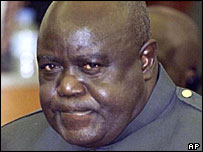
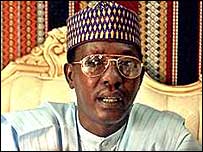
Besides 8.6m of its own, Chad currently hosts about 200k Darfuri refugees and over 30k central africans. It somehow survived the drought, locust invasions and pockets of famine experienced by its neighbors, particularly Niger, in 2005. Yet it is an increasingly unstable place, poised on the precipice of political freefall and potential violence, both internally and with its bellicose neighbor, the Sudan. President Idriss Déby, a 53-year-old former army commander who led an armed revolt from the east to seize power in 1990, is a sick man; he is rumored to have Hep E, HIV and cirrhosis of the liver all at once. Most observers expected him to fall to terminal disease or a forced ouster before the end of 2005. A recent photo captures the opulent insulation of a man with many worries and fewer friends.
Where is my tribe?
Infrastructure at all levels within Chad remains profoundly underdeveloped, in part due to ongoing instability and periods of conflict. Natural resources in rural regions struggling to sustain large refugee influxes in the south and east —wood and water, primarily— are severely depleted, giving rise to resource-related conflict between refugees and host populations.
Since Darfur exploded in early 2003 and eastern Chad found itself overrun with Sudanese refugees, the UN-led humanitarian response has stabilised into a well-run care and maintenance operation. Relations between humanitarian agencies and local Chadian authorities and populations, however, are worsening as resentment and pressure to assist destitute locals grows. During my last visit in October 2005, over 200 Chadian troops from the elite presidential guard deserted their post in protest against the Déby regime. More recently, Déby declared a "state of belligerence" with Sudan after a rebel attack on 18 December in the eastern border town of Adre. Chad blamed the attack on Sudan, saying it is financing, arming and equipping Chadian rebels. The two countries have long accused one another of backing rebel factions. This time, Sudanese support seems real. On 30 December a number of rebel factions - all insisting that Deby step down - announced that they were joining forces (Reuters).
A Zagawan himself, Zagawan allegiances across the Chad-Sudan border explain Déby's tenuous relations with Khartoum but offer little predictive capacity regarding Chad's internal instability, itself due to extensive rivalry between Zagawan factions. The Kobe sub-tribe, around Tine and Bahai, object to Déby's recent appointment of his brother as the Sultan of Bahai. Disagreement over the question of support to Sudanese Zagawa in their fight against the Sudanese government, which Déby reportedly forbids, is a source of broader opposition. Zagawan elements of the rebellion in northern CAR do not, however, pose a direct threat to Déby.

Between its more powerful neighbour, Sudan, and Deby's primary political constituency, his Zagawan kinsmen, the Chadian President has effectively held onto power by not choosing sides. While this may appease Khartoum, the strategy has triggered hostilities from Chadian and Sudanese Zagawa, the latter having been instrumental to Déby's successful overthrow of former
President Habré, and now leading the Darfur insurgency. Once thought too disparate to present a credible threat to Déby, the now unified alliance may alter the balance, particularly if Sudanese Zagawans and Janjawid offer support.
Déby's political credibility hinges on his continued ability to prevent an overflow of armed conflict from Darfur and Northern CAR into Chad, a capacity that appears to be slipping from his grasp. His current unpopularity with the rank and file owes more to his being blamed for the country's economic malaise, and to rising anti-Zagawan sentiment nationwide. Regular cabinet reshufflings allow him to placate opposition leaders while ensuring the inefficacy of his administration. While the government denies reports of forced recruitment to bolster an army hit by desertions, security forces continue to assault civilians in the capital as tensions mount across the country.
As if this were not enough for a syphillitic former warlord, Déby is fighting fires on another front, with the grand-daddy of international donors, the World Bank.
My oil, my money
Of other large rumblings I heard during my last Chad visit, that over the World Bank-funded Chad-Cameroon oil pipeline, the situation is has since deteriorated. The Washington Post recently summarized the dispute:
"Despite objections by critics that oil money in such countries is almost invariably squandered or stolen, the bank backed the pipeline in the hope of showing that Africa could use its mineral riches to benefit the poor. It secured an agreement with Chadian leaders that most of the government's oil proceeds would go into a closely supervised escrow fund in London, to be disbursed and invested on the nation's behalf in areas such as education, health and rural development.
"Out of cash for its regular budget amid mounting security problems involving army deserters and refugees on the border with Sudan, the government announced in October that it intends to amend the law governing the petrodollars so it can use a larger chunk of the money for any purpose it likes, including its security forces. Under the proposed new law, the government would double, to 30 percent, the amount of oil money that it can spend without oversight. The government would also halt the diversion of 10 percent of the oil money into a "future generations" fund that is to be spent only after Chad's oil wells run dry.
"All this poses a tough dilemma for Wolfowitz, the former U.S. deputy defense secretary who took the bank's helm last June pledging to put a high priority on intensifying the bank's anti-corruption efforts. The bank has the legal right to take punitive measures in response to any action by the Chadian government to change the agreement, which so far has generated more than $300 million in revenue for public purposes in Chad. But the bank is instinctively loath to cut off financial ties with a country; it argues that the country's poor are likely to suffer most from the withholding of aid -- a painful prospect in Chad, one of the world's most impoverished nations, where 80 percent of the population relies on subsistence farming and livestock raising. On the other hand, if Wolfowitz is too flexible with Chad, he risks exposing the World Bank and himself to criticism that the fight against corruption is little more than hot air.
"The [Chadian] government's cash squeeze suggests that misappropriation of public resources is continuing apace. Normal budget accounting is nonexistent, and bank officials cannot understand how the government can be broke, especially since it has directly received some of the oil money, about $38 million, for its general budget. Allowing the government to take money from the London escrow fund might only invite further waste and would set a terrible precedent for future projects in the oil and mining sector, bank officials fear, by signaling that such "ring-fencing" arrangements don't work."
What of the Chadian argument for reneging on these agreements? "The government has good reason for insisting on changing the agreement. Although world oil prices have roughly doubled since the pipeline deal was signed, the revenue going to the government has been "disappointing," said a Chadian minister, and the government questions the international oil companies' explanation that much of the petroleum being pumped is laden with impurities. "We understand that in principle it's good to save for the future. But the people of Chad don't understand why they should be told they must save for future generations when they have needs right now." Spending money to improve security in the often-lawless countryside, he added, is perfectly consistent with poverty reduction, because "we can't conceive of economic development in an environment which is not secure."
Yes, it's grim
After stillborn efforts at dialogue, today the Bank announced it would suspend Chad's loans for the $4.1 billion project in retaliation for recent Chadian legislation that doubles the percentage of oil revenues the can be spent without oversight, to 30 percent. Chad's National Parliament also scrapped a requirement that 10 percent be set aside in a fund to be used once oil resources run out.
The Bank had lent Chad more than $39m on condition that non-government groups checked its use of oil revenues. The private sector arm of the World Bank, the International Finance Corporation, also lent another $100m and mobilised a further $300m for the pipeline.
Whether Chad's increased security spending will create the stability necessary for development remains to be seen, as Chad's finance minister, Abbas Mahamat Tolli, contended in a recent interview. Revenue to date from the pipeline has not been directed to the social sector as promised. In 2005, Deby managed to pass a law allowing him three terms in office, effectively undermining any pretense to democracy. Former comrades-in arms, in particular Chad's ambassador to Washington, Ahmat Soubiane, was ousted in November and is now seeking asylum in the US (Washington Post).
Chad tied with Bangladesh in Transparency International's 2005 list of most corrupt countries.

Wednesday, January 04, 2006

Arms trafficking in the Great Lakes region


The Brussels-based thinktank, Groupe de Recherche et d'Information sur la Paix, or GRIP, published a study I did in late 2004 on armed violence against women in Burundi. GRIP does a lot of interesting work on the Great Lakes region in general, including an excellent study by Charles Nasibu Bilali (recently liberated from prison in Burundi) on regional arms trafficking and the Mai-Mai popular defense forces operating in the DRC since the 1960s. For these and other reports, look under 'publications' on the GRIP site.

Post-elections, Burundi's arms problem persists


From an article published in the Old Town Review on Burundi: "Behold the miniature African republic of Burundi, land of a thousand hills and tens of thousands of small arms. Arms proliferation among civilians, military, and ex-combatants across Burundi is a central factor in the continued instability plaguing the country, undermining fledgling peace efforts poised to end ten years of fighting."

on the congo river (photo j. brachet)

first firstlings


bring me my sword, young bhoddus!