A portal to my writing on stateless states, populations in danger and analog adventure

I've been in Uganda's remote and arid Karamoja region for the last few weeks looking at abuses against children by local warriors and in the government's forcible disarmament program. A fascinating context, but the real attraction has been the bird life!

2.jpg)


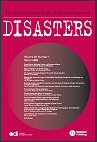
Hurricane Katrina struck the New Orleans area early morning August 29, 2005. The storm surge breached the city's levees at multiple points, leaving 80 percent of the city submerged, tens of thousands of victims clinging to rooftops, and hundreds of thousands scattered to shelters around the country. Three weeks later, Hurricane Rita re-flooded much of the area.


Read more from the new Crisis Group Report on recent events, called "Guinea: Change or Chaos""Fifty-eight countries represented at a high-level conference in Paris today committed themselves to stopping the unlawful recruitment and use of children in
armed conflicts.
[Former child soldier Ishmael Beah holds up the Paris Commitments at the end of the historic ‘Free Children from War’ conference in Paris.]
The Paris Commitments, as they are now known, lay out detailed guidelines for protecting children from recruitment and for providing assistance to those already involved with armed groups or forces. They will complement the political and legal mechanisms already in place at the UN Security Council, the International Criminal Court and other bodies trying to protect children from exploitation and violence.
The conference, which was jointly organized by the French Government and UNICEF, attracted dozens of government ministers, donors, the heads of several UN agencies – including UNICEF Executive Director Ann M. Veneman – and many non-governmental organizations."Read more about the Paris conference here.
And read the recent NYT article on Ishmael Beah and his forthcoming memoir called “A Long Way Gone: Memoirs of a Boy Soldier,” babout life as a child soldier here.
So stands the threat of fillibuster by poor nation member states, who oppose the UN reform agenda that new Secretary General Ban Ki-moon inherited from Kofi Annan.
If I'm not here clicking and typing away for this blog, I'm probably at 3 Quarks Daily where I write longer pieces as a guest columnist every fourth Monday.


In the past, President Bashir has claimed that outside efforts to save lives in Darfur were a ploy to mask western interference in Sudan’s internal affairs. The Addis-Abuja proposal clearly negates that claim, coming as it does with support from the AU, Arab League and UN Security Council (including China). This is an African and Arab-supported plan to save Sudanese lives. Mr Bashir has no more excuses. [...]"
The BBC reports on the conclusions of the marathon Mengistu trial:The former leader was tried in his absence. He has been in exile in Zimbabwe since being ousted in 1991 and many fear he will never face justice. In a notorious campaign - known as the Red Terror - thousands of suspected opponents were rounded up and executed and their bodies tossed on the streets. Mengistu and dozens of his officials could face the death penalty. " [read rest here]
Mugabe in Zimbabwe of course refuses to extradite Mengistu. Hoorah, the African Old Boy's Club is alive and well. No surprise there.
Still, the Mengistu conviction is surprising. Mostly, why genocide--what 'genus' of Ethiopians were targeted and killed, besides those sharing the non-physical trait of opposing socialist policies implemented by the Dirgue, the military junta that ousted Haile Selassie in 1974?
Literature on Ethiopia's 'Red Terror' tends to amalgamate the government-sanctioned killing of political dissidents with those who died from famine (approx. 1.5 million) in rural areas in the late 70s and early 80s. These deaths resulted, so the argument goes, from land redistribution programs that forced the resettlement of hundreds of thousands of farmers to uncultivated, barren areas of the country. Little information is available on the legal arguments used to frame the totality of these deaths as genocidal, which would require proof of a state apparatus constructed deliberately for the single purpose of identifying and terminating the lives of individuals exhibiting certain physical traits. Rwanda and Nazi Germany are the classic examples.
My sense has always been that Mengistu's Ethiopia fashioned itself (with Soviet support) a laboratory for Marxist land reform schemes that failed miserably, such that millions perished, as lab rats do in any controlled environment when an experiment runs amok. Large scale humanitarian tragedy, yes, made even worse by a lack of justice for its victims. Social engineering in hyper-drive, yes, but a genocide?
The affair also made me do a quick mental inventory of other African dictators who absconded with their crimes--where are they now?
Idi Amin, the self-proclaimed 'King of Scotland', died in Jeddah in 2003 after a long exile. His ouster by Tanzanian troops ('regime change' a l'africaine) in 1979 ended an eight year rule. Amin never faced trial for his alleged crimes. Up to 400,000 people are believed to have been killed under his rule. [Amin in reflection: "No coffee, just more medals."]
Chad's Hissein Habre is still alive in Senegal, having fled in 1990 after ouster by Idriss Deby, the country's currently beleaguered president. A Chadian government inquiry accused Habre's regime of 40,000 political killings and 200,000 cases
of torture during his 1982-1990 rule. After significant international pressure and a call for extradition for trail in Belgium, Senegal agreed to undertake Habre's trial. It has requested international funding to do so.
[With Mitterand, looking rather like a Whirling Dervish.]
Liberia's Charles Taylor first found refuge in Nigeria, but has since been extradited to the ICC in the Hague. He is accused of funding Sierra Leone's former rebels, the Revolutionary United Front by selling diamonds on their behalf and buying weapons for them. R
UF fighters were notorious for hacking off the arms and legs of the civilian population with machetes, as well as killing, raping and robbing them.
[See other charges against Taylor here]


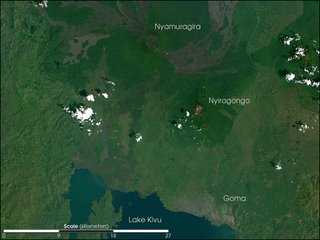
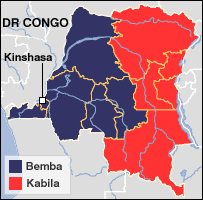
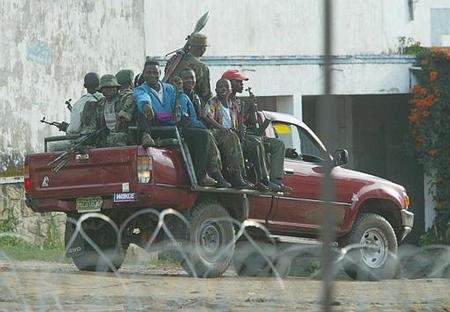
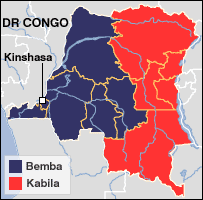
What other country can boast such diverse forms of crippling instability, all occuring simultaneously? If the Bemba fanatics in Kinshasa dont lynch you for speaking Swahili and supporting Kabila, Nkunda's men around Goma will gladly terminate you on suspicion of 'oppressing Tutsis'. And don't go seeking refuge in the wilds around Goma, as you're sure to get cooked by fresh lava flows from Mt. Nyamuragira, which erupted last night just outside of town.

In the event of any lingering doubts you might have about the facts of the Rwandan genocide, have no fear. France is now the self-proclaimed expert on what triggered the genocide, and who is responsible. A French court has issued warrants for their arrest. The indicted happen to be nine of President Paul Kagame's closest government aides--including armed forces chief James Kabarebe and army chief-of-staff Charles Kayonga.
Such was the old Rwandan flag, so devoid of creativity they had to put a big 'R' in the middle to distinguish it from the dozens of other African countries with this same color format.


For 2007 UN agencies are considering intensive programming aimed at establishing the equal rights of Congolese Pygmies (Bambuti and other groups) long denied by the Bantu groups dominating Congolese society, politics and administration. There is little to romanticize in the Pygmy's remote and rustic lifestyle, whose perpetuation is largely the direct result of relentless discrimination by the Congolese majority. A National Geographic site covers their status in the country today, complete with accusations of cannibalism committed against various Pygmy groups by presidential candidate Jean-Pierre Bemba's armed group, the Mouvement pour la Liberation du Congo (MLC). The degree to which they are subjected to an unparalleled degree of humiliation, ridicule and abuse by Bantu groups across the country explains their currently abject state.
Within the last five years, I have had the occasion to work directly with Pygmy groups outside Isiro, Orientale, and in the Mai Ndombe region of northern Bandundu. In both instances I was struck by the automatic and fierce prejudice with which they were treated by the surrounding Bantu Congolese, people who were living at basically the same level of extreme indigence and dispossession as the Pygmies themselves. The other primary characteristic of their misery was the degree to which they had internalized the Bantu discourse of their inferiority and ignorance.
They were at such a nadir that they actually believed the racist slander to which they were constantly subjected; their inferiority complex was total and all-consuming. Every aspect of their lives was to them proof not of the injustice of the discriminatory discourse around them but of their own failure, their incompetence, their baseness. Their identity as they expressed it in focus group discussions consisted precisely of the very insults they heard throughout their lives from their Bantu neighbors. It was stunning and tragic—they were totally brainwashed. I would not be surprised if the majority of Pygmy communities in the DRC suffered this same degree of self-abnegation, the result of the extreme prejudice and humiliation to which they are constantly subjected.
I am curious to see how the UN approaches this issue: clearly Congolese society is at fault, rife as it is with profound racism and prejudice towards its original inhabitants. Project proposals I have seen base themselves on UN legal precedents recognizing and protecting the rights of indigenous groups, based on the principle of 'autochthony'.
I’m not convinced that in a Congolese context the autochthony argument is the most appropriate to defend/restore their rights and equality. Autochthony as the right to equal treatment of oppressed indigenous groups has its role in international law, although I'm quite sure no such precedent exists in Congolese law.
But are victimhood and a history of oppression the most constructive rhetorical arguments to restore equality between peoples? Victimhood as a tool of empowerment—'victimhood' being a placeholder for autochthony given the oppression indigenous peoples have universally experienced—does not seem to result in sustainable integration or equality between peoples; it simply perpetuates a discourse of difference, resentment and the ‘you owe us’ mentality. If such is the result, I dont see how it can serve the objectives of integration or equality at all.
Even the Congolese see themselves largely as the ‘victims’ of Rwanda, the international community, colonialism, ad infinitum, to the point where they take no responsibility for their predicament because ‘the world owes them’. As anyone who has spent a long time in this country would agree, this enormous and largely vacuous grievance has achieved nothing for the Congolese. My sense is that autochthony—often a sanitized synonym for ‘oppressed group’—as a rhetorical argument to assert the equality of minorities can backfire with disastrous consequences. What worse fate for the Pygmies to go from the frying pan into the fire by trying to beat back ingrained Bantu prejudice with the victim argument... . But, who knows, there are definitely no geniuses at the helm.
More as the 'plotting for Pygmy equality' unfolds...


Whew -- happy to get out of Kinshasa before elections tomorrow; tensions real and imagined are in the ascendant. Kinshasa, the giant anthill of 'inhabited devastation' (Conrad), is the night of Lubumbashi's day, where I landed today, quite malarial from too many bloodsuckers in my crappy Kinshasa hotel room.