A portal to my writing on stateless states, populations in danger and analog adventure
Thursday, June 28, 2007
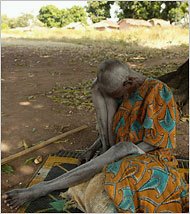
Congolese Pygmies in a master/slave dynamic with local Bantu

Monday, May 28, 2007
Could France’s new odd couple—Sarkozy and Kouchner—spell the end of French privilege for Africa’s most venal?

Sunday, May 06, 2007
Evaluating hurricane recovery in the US
Hurricane Katrina struck the New Orleans area early morning August 29, 2005. The storm surge breached the city's levees at multiple points, leaving 80 percent of the city submerged, tens of thousands of victims clinging to rooftops, and hundreds of thousands scattered to shelters around the country. Three weeks later, Hurricane Rita re-flooded much of the area.As someone who works on disaster relief programs worldwide, I was invited to come for a month and evaluate the strengths and weaknesses of various projects in New Orleans and Biloxi, two centers of urban devastation. The experience thus far has been surprisingly positive and inspiring, an unexpected antidote to my entrenched cynicism regarding relief efforts in places like Darfur or Congo, where I typically work.
[...] I've pondered over some perhaps facile but nonetheless empirical truths about the dynamic of human response to extreme disasters.
Read the rest of this post at 3 Quarks Daily...
Monday, April 23, 2007
The ICC and the war in northern Uganda

The ICC: ‘A giant without arms or legs’

Monday, March 05, 2007
Evangelical aid agencies finally under scrutiny
An AP report from Uganda addresses the professionalism and qualifications of one such organization, Samaritan's Purse, led by Franklin Graham, Reverend Billy Graham's son. Billy Graham was described by Time magazine as an American 'hero and icon' of the twentieth century.

The AP story begins:
"Telephone to Jesus. Hello?" the children of Aler refugee camp in northern Uganda sing, their bare feet thumping the ground as they dance wildly in their concrete chapel. Most camp residents have never used a phone, but they are learning about Jesus. The Rev. Franklin Graham, son of famed evangelist Billy Graham, smiled as he watched the children — members of a club run by Samaritan's Purse, the Christian missionary organization he leads.
Critics accuse them of taking advantage of vulnerable communities — forcing people to abandon traditional beliefs in exchange for desperately needed goods and medicine. Graham, though, says his group is meeting spiritual as well as physical needs, and he's proud of what has been accomplished.
Read the rest of the story here.
In 2003, Slate reported on Franklin's global vision as informed by his faith. It is worth a read, and starts thus:
"Franklin Graham is the son of Billy Graham and a far more influential figure in the evangelical Christian community than Jerry Falwell or even Pat Robertson. Graham is viewed as the torch-carrier for his father, who is still among the most beloved figures in American Christianity. Moreover, the Graham family is close to Bush. Billy Graham led Bush to Christianity in the 1980s; Franklin Graham delivered the invocation at his presidential inauguration.
In addition to being publicly allied with the Bush administration, Graham also happens to be stridently anti-Islam. His list of anti-Islam comments is long; his most succinct was that Islam is a "very evil and wicked religion."
Thursday, February 15, 2007
Guinea: Arising after two decades of civic slumber

From ICG's new report: "Guinea has been dominated for nearly 23 years by the unique figure of General Conté, corrupt and desperate to hold onto his privileges. The opposition to the Conté regime, begun during the general strike at the beginning of the year, has taken a bloody turn and has mutated into an unprecedented popular uprising.
Guinea now faces two possible scenarios. There is still a chance, though a diminishing one, for a negotiated solution involving key Guinean, regional and wider international actors. Alternatively, if the Conté regime continues to rely on military repression, it could rapidly bring Guinea to a dramatic spiral of violence: full popular insurgency, with increasing chaos that is likely to stimulate a military take-over in a blood-bath, leading in turn to a possible civil war comparable to those that have torn apart its neighbours in the past decade and with uncontrollable consequences.
Western governments as well as multinational firms that benefit from the country’s natural resources value political quiet but they would be making a serious mistake if this led them to support, even by passivity, an effort to retain the Conté system (with or without its creator)."
Read more from the new Crisis Group Report on recent events, called "Guinea: Change or Chaos"BBC is doing some good reporting as well here.
Wednesday, February 07, 2007
Paris: New proscriptions against use of child soldiers
"Fifty-eight countries represented at a high-level conference in Paris today committed themselves to stopping the unlawful recruitment and use of children in
armed conflicts.
[Former child soldier Ishmael Beah holds up the Paris Commitments at the end of the historic ‘Free Children from War’ conference in Paris.]
The Paris Commitments, as they are now known, lay out detailed guidelines for protecting children from recruitment and for providing assistance to those already involved with armed groups or forces. They will complement the political and legal mechanisms already in place at the UN Security Council, the International Criminal Court and other bodies trying to protect children from exploitation and violence.
The conference, which was jointly organized by the French Government and UNICEF, attracted dozens of government ministers, donors, the heads of several UN agencies – including UNICEF Executive Director Ann M. Veneman – and many non-governmental organizations."Read more about the Paris conference here.
And read the recent NYT article on Ishmael Beah and his forthcoming memoir called “A Long Way Gone: Memoirs of a Boy Soldier,” babout life as a child soldier here.
Monday, February 05, 2007
UN Reform: "Death by 1,000 meetings"
So stands the threat of fillibuster by poor nation member states, who oppose the UN reform agenda that new Secretary General Ban Ki-moon inherited from Kofi Annan.The secretary-general, in an effort to balance posts between major contributors and poor nations, urged 192 member states in the General Assembly to back his proposals to split the peacekeeping department in two and downgrade disarmament affairs but attach it to his own office."
My Life in the Bush of ... 3 Quarks Daily
If I'm not here clicking and typing away for this blog, I'm probably at 3 Quarks Daily where I write longer pieces as a guest columnist every fourth Monday.3 Quarks is a happy place, and comes highly recommended from notable big brains Steven Pinker, Richard Dawkins, even David Byrne.
Editor and friend S. Abbas Raza describes the aim and structure of the site:
On this website, my guest authors and editors and I hope to present interesting items from around the web on a daily basis, in the areas of science, design, literature, current affairs, art, and anything else we deem inherently fascinating. We want to provide you with a one-stop intellectual surfing experience by culling good stuff from all over and putting it in one place. In other words, we are what has come to be known as a "filter blog." And we try not to be afraid of challenging material. Though we are a filter blog on all other days, on Mondays we have only original writing by our editors and guest columnists.
Hope you will drop by for a visit...
Wednesday, January 31, 2007
NGOs to UN: 'Stop Playing Donor!'
The fundamental flaw of the CERF mechanism is that non-UN aid agencies, like Save the Children, are not allowed to receive direct funding from international donors, despite the fact they are usually first on the ground and deliver more than half of all emergency relief.
Basically, where NGOs like Save the Children traditionally get their money directly from donor governments to implement aid programs on the ground, the creation of large funding pools like the CERF mean the introduction of two new 'middle men' into the equation: the CERF itself (located in Geneva) and the UN agency dispensing the cash in country to the receiving NGO. I recently evaluated a similar fund called the Rapid Response Mechanism and found more positive results in terms of impact for beneficiaries. Donors tend to like the CERF and other UN-created funds because it fits with donor governments' desires to see a more robust, accountable UN. NGOs are divided on whether the new middle men are an added value, and Save is clearly opposed.
Their points about overheads are valid. Both UN agencies and the aid agencies carrying out project work are entitled to take a 7% cut of donor funding to pay for overheads and support. Save the Children’s research finds that, if both the UN agency and the implementing aid agency take overheads, only 86p per pound reaches the beneficiaries compared to 93p if non-UN agencies were given funding directly.
Save the Children is calling on the UN, and specifically the CERF board members, to cut out the middle-man and change the rules to allow aid agencies to access the fund directly in the same way as UN agencies.
Read the SC-UK report here: Exclusion of NGOs: The Fundamental Flaw of the CERF
Tuesday, January 30, 2007
'Third World': Expect spacejunk from Davos

[An MIT rep demonstrates the $100 laptop]
I'm not one to call the kettle black, for the international development and disaster relief business is rife with fantasies and funding dedicated to a 'better world' for the most destitute of the planet. But at Davos, where so many rich people and self-proclaimed visionaries mingle annually, one would expect their underlings to have researched what prior forms of literacy, infrastructure and knowledge are required if a computer is to mean anything other than spacejunk to an subsistence farmer, a former child soldier, or the third wife of a man with 27 children to feed.
I'm soon headed to northern Uganda to research violations against children by the Lord's Resistance Army and the Ugandan National Army. I'll keep one eye skyward for any falling laptops--although such spacejunk is already common in rural Africa. I used to work with Dinka pastoralists in Southern Sudan who decorated their cattle by hanging discarded CDs from their horns. The CDs were recovered from the trash pits of international NGOs working to improve the lives of southerners during the war with Khartoum. Of course they had no idea what the CDs were, other than round reflective disks once used by foreigners. What would the Dinka do with laptops? Maybe trap wild game in the mighty jaws of the hinge mechanism connecting keyboard and screen.
Monday, January 08, 2007
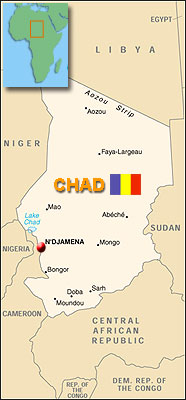
Sudan, Chad and CAR: a cauldron for civilians

The nexus of conflict and refugee flows between Darfur, Eastern Chad and the Central African Republic continues to boil over, with tragic impact on civilian lives. The Council on Foreign Relations just released this concise summary of the dynamic and its humanitarian consequences.
Wednesday, January 03, 2007
Rwanda mediates between DRC govt and Nkunda

Rwanda is mediating in talks between a government delegation from neighbouring Democratic Republic of Congo and renegade Congolese General Laurent Nkunda, a Rwandan military spokesman said Wednesday. "This shows the confidence the Congolese government has in the government of Rwanda," he said.
Nkunda launched attacks on Congolese army positions near North Kivu's provincial capital Goma in late November, sparking on-off fighting.
Read the Reuters article here.
Wednesday, December 27, 2006
DRC: "Dubious mining deals..."

John LeCarre, the celebrated author, and Jason Stearns,
analyst for the International Crisis Group, published an op-ed in the Boston Globe just before Christmas describing the
challenges to establishing fiscal legitimacy in DRC post-elections.
"JOSEPH KABILA was recently sworn in as president of the Democratic Republic of Congo. The ceremony marked the end of a tumultuous peace process that led the country out of seven years of war. [...] But dubious mining deals between the Congolese government and international corporations may be threatening the nation's chances of rising from the ashes."
Read "Getting Congo's wealth to its people" here...
Monday, December 18, 2006
Uganda: Is the ICC a carrot or stick to the LRA?

[LRA: children killing children]
The answer is much more complicated. Local perceptions and opposition to the ICC in Uganda are extremely high, despite popular will to see an end to the ruthless terror of the Lord's Resistance Army in the north. Published by Zed Books, Tim Allen's recent book defends the institution's pursuit of LRA leaders and tries to understand Ugandan opposition to the ICC.
From the publisher's note, "The International Criminal Court has run into serious problems with its first big case - the situation in northern Uganda. There is no doubt that appalling crimes have occurred here. Joseph Kony‘s Lord‘s Resistance Army have abducted thousands, many of them children, and have systematically tortured, raped, maimed and killed their victims.
Nevertheless, the ICC has confronted outright hostility from a wide range of groups, including traditional leaders, representatives of the Catholic and Anglican Churches, and non-governmental organizations. Even the Ugandan government, which invited the ICC to become involved in 2003, has been expressing serious reservations. For many, the Court is spoiling the peace process and is making continued warfare and suffering more likely.
This book argues that much of the antipathy to the ICC is based upon ignorance and misconception. Drawing on field research in Uganda, it shows that victims are much more interested in punitive international justice than has been suggested, and that the ICC has made resolution of the war more likely."

Darfur: Western diplomats press for sanctions
Sanctions would force change of policy in Sudan.
A proposal from 15 former foreign ministers...
"The surest way to save lives in Darfur would be through a fully observed ceasefire leading to a sustained political settlement that allows refugees and the displaced to return to their homes. In the interim, the under-manned and under-equipped African Union peacekeeping force must be enlarged and strengthened. In meetings in Addis Ababa and Abuja last month, a broad diplomatic coalition recommended a hybrid force that would combine AU personnel with financial, logistics and other support from the United Nations.
In the past, President Bashir has claimed that outside efforts to save lives in Darfur were a ploy to mask western interference in Sudan’s internal affairs. The Addis-Abuja proposal clearly negates that claim, coming as it does with support from the AU, Arab League and UN Security Council (including China). This is an African and Arab-supported plan to save Sudanese lives. Mr Bashir has no more excuses. [...]"Friday, December 15, 2006
Ethiopia: Mengistu convicted... of genocide?
The BBC reports on the conclusions of the marathon Mengistu trial:"Ethiopia's Marxist ex-ruler, Mengistu Haile Mariam, has been found guilty of genocide after a 12-year trial.
The former leader was tried in his absence. He has been in exile in Zimbabwe since being ousted in 1991 and many fear he will never face justice. In a notorious campaign - known as the Red Terror - thousands of suspected opponents were rounded up and executed and their bodies tossed on the streets. Mengistu and dozens of his officials could face the death penalty. " [read rest here]
Mugabe in Zimbabwe of course refuses to extradite Mengistu. Hoorah, the African Old Boy's Club is alive and well. No surprise there.
Still, the Mengistu conviction is surprising. Mostly, why genocide--what 'genus' of Ethiopians were targeted and killed, besides those sharing the non-physical trait of opposing socialist policies implemented by the Dirgue, the military junta that ousted Haile Selassie in 1974?
Literature on Ethiopia's 'Red Terror' tends to amalgamate the government-sanctioned killing of political dissidents with those who died from famine (approx. 1.5 million) in rural areas in the late 70s and early 80s. These deaths resulted, so the argument goes, from land redistribution programs that forced the resettlement of hundreds of thousands of farmers to uncultivated, barren areas of the country. Little information is available on the legal arguments used to frame the totality of these deaths as genocidal, which would require proof of a state apparatus constructed deliberately for the single purpose of identifying and terminating the lives of individuals exhibiting certain physical traits. Rwanda and Nazi Germany are the classic examples.
My sense has always been that Mengistu's Ethiopia fashioned itself (with Soviet support) a laboratory for Marxist land reform schemes that failed miserably, such that millions perished, as lab rats do in any controlled environment when an experiment runs amok. Large scale humanitarian tragedy, yes, made even worse by a lack of justice for its victims. Social engineering in hyper-drive, yes, but a genocide?
The affair also made me do a quick mental inventory of other African dictators who absconded with their crimes--where are they now?
Idi Amin, the self-proclaimed 'King of Scotland', died in Jeddah in 2003 after a long exile. His ouster by Tanzanian troops ('regime change' a l'africaine) in 1979 ended an eight year rule. Amin never faced trial for his alleged crimes. Up to 400,000 people are believed to have been killed under his rule. [Amin in reflection: "No coffee, just more medals."]
Chad's Hissein Habre is still alive in Senegal, having fled in 1990 after ouster by Idriss Deby, the country's currently beleaguered president. A Chadian government inquiry accused Habre's regime of 40,000 political killings and 200,000 cases
of torture during his 1982-1990 rule. After significant international pressure and a call for extradition for trail in Belgium, Senegal agreed to undertake Habre's trial. It has requested international funding to do so.
[With Mitterand, looking rather like a Whirling Dervish.]
Liberia's Charles Taylor first found refuge in Nigeria, but has since been extradited to the ICC in the Hague. He is accused of funding Sierra Leone's former rebels, the Revolutionary United Front by selling diamonds on their behalf and buying weapons for them. R
UF fighters were notorious for hacking off the arms and legs of the civilian population with machetes, as well as killing, raping and robbing them.
[See other charges against Taylor here]
Monday, December 11, 2006
UN Convention against Corruption: will it have teeth?

Transparency International looks at corruption from several angles. Its Global Corruption Barometer tries to show corruption through the eyes of ordinary citizens, by polling around 59,000 people in 62 different countries. It asks people their opinions about which public sectors are most corrupt, and which spheres of life are most affected by corruption (family, politics, business), and how their government is doing in its fight against corruption. This Barometer report investigates bribery particularly--who pays what to whom, why and how much--particularly regarding the forces of order (police, military, civil servants).
International Anti-corruption Day is in recognition of the signing of the United Nations Convention against Corruption (UNCAC) in Mexico three years ago. This agreement (in PDF here) came into force last year: 140 countries have now signed on, and 80 have ratified. DR Congo is not among them.
From 10 to 14 December, the UNCAC countries will meet in Jordan to decide the fate of the agreement: the funding of monitoring, how to ensure compliance and secure the repatriation of stolen wealth, among other issues. Compliance, or enforcement of norms, and the repatriation of stolen wealth are of obvious relevance to numerous African countries, particularly those with natural resources and little effective control over their extraction.
On unregulated resource extraction in Africa, the lobby group Fatal Transactions is active and interesting. Their March 2006 report on extractive mining in Katanga, DRC, is worth a look: "The State vs. the People. Governance, mining and the transitional regime in the Democratic Republic of Congo".
Sunday, December 10, 2006
CAR: Staging ground for regional conflicts

And is itself a powderkeg.... Intelligent coverage about dynamics in this little understood region in today's NYT:
The Central African Republic — so important as a potential bulwark against the chaos and misery of its neighbors in Chad and the Darfur region of Sudan — is being dragged right into the dangerous and ever-expanding conflict that has begun to engulf central Africa.
So porous are its borders and ungoverned are parts of its territory that foreign rebels are using the Central African Republic as a staging ground to mount attacks over the border, spreading what the United Nations has called the world’s “gravest humanitarian crisis.”
Read more here...
Tuesday, November 28, 2006
DRC: Volcanoes, rebel attacks and tense elections all in one day
What other country can boast such diverse forms of crippling instability, all occuring simultaneously? If the Bemba fanatics in Kinshasa dont lynch you for speaking Swahili and supporting Kabila, Nkunda's men around Goma will gladly terminate you on suspicion of 'oppressing Tutsis'. And don't go seeking refuge in the wilds around Goma, as you're sure to get cooked by fresh lava flows from Mt. Nyamuragira, which erupted last night just outside of town.Official election results were announced last night by Supreme Court officials in Kinshasa. They spoke under heavy armed guard from their temporary digs in the Ministry of the Interior, following last week's incendiary ravaging of the Supreme Court building by rabid Bemba supporters. Never has the thirst for lawlessness been more accurately expressed. Dont care for rule of law? Just burn down the Supreme Court.
In any other country, tanks would have flooded the streets in retaliation, and martial law immediately declared. In Kinshasa, police forces stood agape for a few reflective moments before the ravenous crowd of assailants, and promptly fled. UN peacekeepers arrived after the fact. The national army did not respond. Days later, Kabila formally asked Bemba to remove some of his estimated 1000-strong private army, of which around 60 were reported to have left the city. Congolese pundits blamed the international community for letting this 'blow to the heart and soul of Congo's national integrity' transpire uncontested, and in broad daylight. When will Congolese leaders assume the minimum of responsibility for their predicament?
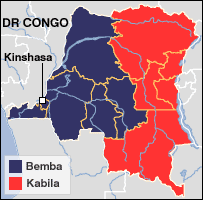
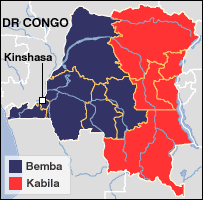
From the BBC election graphic above one notes the clear division in voter preference between East and West, as though little mattered more than the geographical origin of the candidates themselves. Throughout their respective campaigns, neither candidate ever developed much in the way of political platform or agenda for reform. It was largely a high school popularity contest, costing the international community over $400 million. The cult of personality as the primary ingredient of political success in the Congo has changed little from the Mobutu era. Old habits, like dictators, die hard.
Now, Kabila has five years to address the country's problems, or will otherwise (one hopes) be voted out of office. Perhaps that in itself is worth all the effort, risk and cost of introducing democratic process to this country. Immediate benefits are intangible at this point.
On a different front here in the far East of the country, on the Rwandan border, the town of Goma has been on tenterhooks these last few days for very different reasons. Dissident general Laurent Nkunda of the national army has been rallying his forces to take the town of Sake, some 15 miles from Goma.

His apparent intention was to repeat his bloody takeover of Bukavu in June 2004. Then, UN peacekeepers stood by and watched, as the national army itself was crushed by Nkunda's powerful but limited number of men. This time, however, MONUC forces were intent on defending Goma, and spent much of yesterday reclaiming Sake and pursuing Nkunda's men with a combination of ground fire and helicopter gunships.
[displacements in Sake]
Nkunda's attack was reportedly triggered by the summary execution of a Tutsi man at a Sake checkpoint, a man with direct ties to Nkunda. Given Nkunda's pretense of defending his oppressed Tutsi brethren across eastern Congo, the murder provided a convenient pretext to begin military operations again, silent since August 2006.
Having been routed by MONUC forces, today the rumor is that Nkunda is ready to negotiate, although his exact terms and conditions are not clear. Amnesty for war crimes committed during his Bukavu invasion are likely among them.
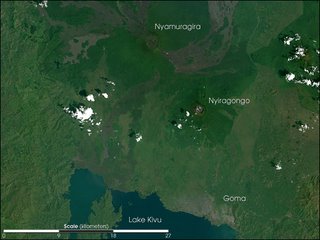
On a final front, just outside Goma at 8pm last night, Mt. Nyumalugira erupted, sending lava 150m into the night sky. There is no threat to the town or its residents, as happened with Nyiragongo in January 2002. Goma town was eviscerated, and thousands were displaced. Whether the gods are crazy, angry or celebrating current events in Congo, no one bothers to speculate. Brute life soldiers on.
[satellite image of Goma, Nyiragongo and Nyamuragira]
Friday, November 24, 2006
Rwanda: France weighs in on genocide
In the event of any lingering doubts you might have about the facts of the Rwandan genocide, have no fear. France is now the self-proclaimed expert on what triggered the genocide, and who is responsible. A French court has issued warrants for their arrest. The indicted happen to be nine of President Paul Kagame's closest government aides--including armed forces chief James Kabarebe and army chief-of-staff Charles Kayonga.They are accused of involvement in the shooting down of a plane carrying Rwanda's former president - an incident the French judge claims sparked the mass slaughter.
The elephant in the room here is the preposterous notion that the downing of then President Habyarimana's aircraft was what triggered the genocide. The French judge, Jean-Louis Bruguiere, is investigating the case because the crew of the plane were French and the families filed a case in France in 1998. The credibility of the case appears to rest on a brazen re-reading of history, whereby the Hutu extremists who murdered over 800,000 Tutsis were somehow directed or at least in collaboration with the Tutsi-led army (RPF), supposedly directed by Kagame from exile in Uganda.
Go France! Invent the facts and make it up as you go--the rest of the world does it equally shamelessly!
I cant believe anyone is taking this seriously. Habyarimana's assassination by surface-to-air missile and the assassination of 800,000 Tutsis by machete and petrol fires are separate events. Thousands of eyewitnesses and survivors to the genocide have already attested to the identity of hundreds of convicted genocidaires, all Hutu, most unapologetic: none of them claimed direction or affiliation from Kagame, or any other Tutsi on the planet. Why would they?
BBC and AFP have been reporting on recent developments:
"The French allegations have sparked anger in the Rwandan capital, Kigali, where around 25,000 people are reported to have taken part in a government-organised demonstration against France. Foreign Minister Charles Murigande told AFP news agency Kigali had recalled its ambassador to Paris as they didn't "see why he should be there at this point"." I'm tempted to drive over to Kigali this weekend and savor all the anti-French ruckus.
On an entirely different front -- I'm a big fan of flags, so I cant avoid commenting on Rwanda's 'new look'.

Here's the new Rwandan flag, since Kagame took power after the events of 1994. It looks kind of South Pacific to me, less austere than the old one below.
Such was the old Rwandan flag, so devoid of creativity they had to put a big 'R' in the middle to distinguish it from the dozens of other African countries with this same color format.
Monday, November 20, 2006
DRC: Effects of Kabila's victory

Last week's announcement of the final results from the presidential elections were met with widespread celebration here in the Eastern provinces. I was in Beni, a commercial center in the Grand Nord part of North Kivu province, and everyone went wild. Not so in the Western provinces, particularly in Kinshasa, where Bemba had the majority. "Awa tozo sepila, kuna na Kin bazo lela" was the assessment of one smiling man here. (Here we're celebrating, there they're crying). Kabila won with 58.3% percent of the vote; turnout was pretty poor but I dont have the exact figure.
Bemba, the loser, claims he will contest the elections through legal process, which remains to be seen. Kinshasa is still tense, but no acts of violence since the announcement have been reported.
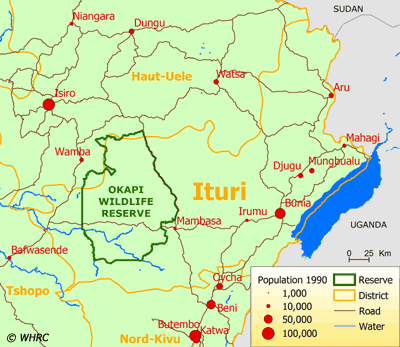
Here in Ituri it is relatively calm, although populations continue to be displaced in clashes between FARDC (govt army) and local militia groups. As the wider Congolese context is pacified, Ituri no longer qualifies as a 'war within a war', as was long the case. Kabila's election is likely to have a positive effect on the disarmament negotiations with local militia leaders, currently underway. Three leaders of different groups "want to be generals in Kabila's army" (they probably didnt vote Bemba!), and this may provide the carrot that should string them down the path of pacification. They are also demanding amnesty from ICC indictment, which remains to be seen. DRC government negotiators are in the area now meeting with the three leaders, something that has never been able to transpire in the past.
Kinshasa voted in favor of Bemba, from Equateur province north of Kinshasa, claiming he's the "son of the soil" (mwana mboka) -- not Kabila, who they argue is really a Rwandan, nor does he speak Lingala. The two candidates represent the two major cultures (east and west) defining and dividing the national psyche. The electoral contest has strained the limits of their compatibility: between east and west, that is.
Perhaps this grievance will abate with time, particularly if Kabila actually does something to improve the lot of the country, which wouldn’t be hard since its lows have never been lower. Political will to do so has been absent in this country for 40 years. For reasons I find incredibly myopic, people in Kinshasa think that whoever runs the country has to speak lingala and hail from Equateur, like Mobutu.
Very little time to blog or even breathe here but hope to catch up soon.
Friday, November 10, 2006
DRC: ICC 'pre-trial' hearing of Ituri militia leader

From a recent Human Rights Watch press release:
"Under rebel leader Thomas Lubanga, in ICC custody since March 2006, the Union des Patriotes Congolaises committed serious crimes in Ituri, including murder, torture, rape and mutilation of civilians. "
[Lubanga with underage cannon fodder]

"For example, UPC combatants under the leadership of Lubanga slaughtered at least 800 civilians on the basis of their ethnicity in the gold mining region of Mongbwalu between November 2002 and June 2003. More than 60,000 civilians have been slaughtered by armed groups in Ituri since the beginning of the conflict, according to the UN."
Human Rights Watch further reports that Lubanga's case will be considered for sufficient evidence before passing to trial, although the only current charges against him concern the recruitment and use of child soldiers. Numerous other rebel leaders, active in Ituri and elsewhere, have much blood on their hands but have been given military posts in the newly integrated national army as a means of securing the cessation of hostilities.
Impunity for rebel leaders is a useful bargaining tool when trying to pacify on the cheap, as the UN Peacekeeping Mission in the Congo is learning. Lubanga was handed over to the ICC as a 'stick' to encourage other rebels to concede to ceasefire terms, though this is not working out as planned. For victims and their families, an ICC trial of Lubanga on the basis of child soldiers is mere theatre, a miniscule comfort given the scale of carnage associated with this war. Yet this possibility for justice in the Hague is the only light in Congo's legal darkness, whose judiciary system is non-existent and revenge the only form of justice available to victims today.
Read the ICC press release here.
Tuesday, November 07, 2006
Congo's Pygmies: Can they be 'made equal'?
For 2007 UN agencies are considering intensive programming aimed at establishing the equal rights of Congolese Pygmies (Bambuti and other groups) long denied by the Bantu groups dominating Congolese society, politics and administration. There is little to romanticize in the Pygmy's remote and rustic lifestyle, whose perpetuation is largely the direct result of relentless discrimination by the Congolese majority. A National Geographic site covers their status in the country today, complete with accusations of cannibalism committed against various Pygmy groups by presidential candidate Jean-Pierre Bemba's armed group, the Mouvement pour la Liberation du Congo (MLC). The degree to which they are subjected to an unparalleled degree of humiliation, ridicule and abuse by Bantu groups across the country explains their currently abject state.
Within the last five years, I have had the occasion to work directly with Pygmy groups outside Isiro, Orientale, and in the Mai Ndombe region of northern Bandundu. In both instances I was struck by the automatic and fierce prejudice with which they were treated by the surrounding Bantu Congolese, people who were living at basically the same level of extreme indigence and dispossession as the Pygmies themselves. The other primary characteristic of their misery was the degree to which they had internalized the Bantu discourse of their inferiority and ignorance.
They were at such a nadir that they actually believed the racist slander to which they were constantly subjected; their inferiority complex was total and all-consuming. Every aspect of their lives was to them proof not of the injustice of the discriminatory discourse around them but of their own failure, their incompetence, their baseness. Their identity as they expressed it in focus group discussions consisted precisely of the very insults they heard throughout their lives from their Bantu neighbors. It was stunning and tragic—they were totally brainwashed. I would not be surprised if the majority of Pygmy communities in the DRC suffered this same degree of self-abnegation, the result of the extreme prejudice and humiliation to which they are constantly subjected.
I am curious to see how the UN approaches this issue: clearly Congolese society is at fault, rife as it is with profound racism and prejudice towards its original inhabitants. Project proposals I have seen base themselves on UN legal precedents recognizing and protecting the rights of indigenous groups, based on the principle of 'autochthony'.
I’m not convinced that in a Congolese context the autochthony argument is the most appropriate to defend/restore their rights and equality. Autochthony as the right to equal treatment of oppressed indigenous groups has its role in international law, although I'm quite sure no such precedent exists in Congolese law.
But are victimhood and a history of oppression the most constructive rhetorical arguments to restore equality between peoples? Victimhood as a tool of empowerment—'victimhood' being a placeholder for autochthony given the oppression indigenous peoples have universally experienced—does not seem to result in sustainable integration or equality between peoples; it simply perpetuates a discourse of difference, resentment and the ‘you owe us’ mentality. If such is the result, I dont see how it can serve the objectives of integration or equality at all.
Even the Congolese see themselves largely as the ‘victims’ of Rwanda, the international community, colonialism, ad infinitum, to the point where they take no responsibility for their predicament because ‘the world owes them’. As anyone who has spent a long time in this country would agree, this enormous and largely vacuous grievance has achieved nothing for the Congolese. My sense is that autochthony—often a sanitized synonym for ‘oppressed group’—as a rhetorical argument to assert the equality of minorities can backfire with disastrous consequences. What worse fate for the Pygmies to go from the frying pan into the fire by trying to beat back ingrained Bantu prejudice with the victim argument... . But, who knows, there are definitely no geniuses at the helm.
More as the 'plotting for Pygmy equality' unfolds...
Saturday, November 04, 2006
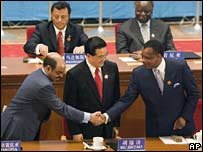
"Trade not Aid": Whither the China-Africa Summit?

From the BBC today: "Beijing is plastered with billboards announcing the China-Africa summit taking place this weekend to highlight the huge and growing relationship with the continent. The summit, called the Forum on China-Africa Co-operation, began on Friday and is being attended by the heads of state and government officials from nearly 50 African nations.
Beijing has been busy wooing Africa in recent years. Trade between the two sides is expected to exceed £27bn this year but the Chinese presence has also drawn criticism. The US and the European Union say that China is dealing with what it calls the repressive regimes of Angola and Sudan, ignoring the wishes of the international community. China has been criticised for ignoring human rights and failing to meet environmental standards. However, increasingly reliant on Africa's resources, Beijing defends its actions.
Trade between the world's fastest-growing economy and the 49 African countries it has diplomatic relations with, increased tenfold from £2bn to nearly £20bn over the past 10 years."
====
The Chinese approach to African development is strictly business, avoiding the 'nation building', governance concerns and 'rights-based assistance' that inform the Western strategy, particularly the UN, donor governments, the World Bank and NGOs. The absence of these carrot-stick methods used by the West is welcome news to many African governments, particularly its most infamous rights abusers, such as Sudan, Angola and DRC--which happen to possess its greatest natural resources.
Will trade with China replace the Western aid machine in Africa's most troubled countries? Twenty to thirty years of foreign aid going to Africa from Western governments have had little impact, and most places are far worse off than they were at the time of independence. This is not the direct fault of the foreign aid machine, of course, but its sustained efforts are not having the desired effect.
Liberal economists and libertarians in the West should laud the Chinese invasion, because the constant hand-holding in the form of charity and aid subsidies by Western institutions has arguably generated a welfare state -- precisely the opposite approach to the domestic policies applied in the US, UK and elsewhere to bootstrap the indigent and marginalized up and out of their dispossessed state. If only the Western aid machine actually created jobs for the beneficiaries of its assistance, I could better defend its presumptions about 'good governance', democracy, and human rights.
Africa's poverty is its greatest challenge since colonialism, that much is incontrovertible. It may well be that increased trade with China allows the man in the street to improve his lot, even as Africa's worst governments remain the unaccountable, cronyistic and self-interested institutions they are today. If so, individuals will stand a better chance of prospering, even if their governments continue to be criminal and inept.
Wednesday, November 01, 2006
DRC: Article on predatory governance

Research I conducted in 2004 in the DRC on the predatory practices of local administrators and the forces of order were documented in a series of internal reports. In 2005 a summary analysis of these practices and their impact on civilian livelihoods was accepted for publication by Disasters: The Journal of Disaster Studies, Policy and Management. The article, entitled "Democratic Republic of Congo: Undoing government by predation," is finally being published.
But isn't the data obsolete? I wish it were; I wish Congo were a completely different place today. Unfortunately little has changed, and the basic humanitarian and economic indicators remain as low as they were in 2004. The study is thus still relevant to the current landscape in DRC. While I dont have the right to post it here, if you are interested let me know by email and I'll send one along.
Here's an outtake from the Executive Summary:
"(...) Government by predation is an endemic and systematic feature of the civil and military administration, ensuring the daily economic survival of soldiers and officials, who are able to wield their authority in a 'risk free' environment, without oversight or accountability. The paper's conclusion tries to make sense of the persistence of corruption in social and political life, and assesses the capacity of ordinary citizens to reverse their predicament."
Saturday, October 28, 2006
Fear and loathing on the eve of DRC elections
Whew -- happy to get out of Kinshasa before elections tomorrow; tensions real and imagined are in the ascendant. Kinshasa, the giant anthill of 'inhabited devastation' (Conrad), is the night of Lubumbashi's day, where I landed today, quite malarial from too many bloodsuckers in my crappy Kinshasa hotel room.I'll be working here this coming week before heading to Ituri and the Kivus. A lovely city, this Lubumbashi, home of Patrice Lumumba, Congo's first and only true martyr; it is long since my favorite. While looking for photos of the place on the web, I ran into this curious site, apparently assembled by former colonials with a deep affection for Katanga, called Inchi Yetu. Loads of images and curios of the region from past and present.

Lots is happening across the country in these final days before voting occurs tomorrow; some of it making international news, much of it not. Kofi Annan is making the usual appeals for calm, most certainly unheard by the illiterate thugs ruling the streets of Kinshasa. Of particular note are events in Gbadolite, Mobutu's former feifdom, where his son Nzanga Mobutu, a presidential candidate in the August elimination round, was taken hostage by Bemba's forces. BBC reports on it here, but do not capture the intriguing nature of the Mobutu - Kabila alliance. I'll elaborate very unscientifically on this clever alliance below.
It seems that young Mobutu wants political relevance at any price , going so far as to ally himself with the son of the man (Laurent Kabila) who drove his father, Mobutu Sese Seko, from power in disgrace and terminal illness in 1996. Two sons of former enemies now joining forces -- stranger things have happened of course, but why this particular alliance? Both are rich as sin, which makes them equals in one way. They can visit their Swiss accounts together, perhaps even share the same private jet.
Jean-Pierre Bemba, the opposing candidate who's wanted by the International Criminal Court, hails from Equateur province, as does the Mobutu family. He married into the Mobutu clan years ago, compounding their riches with his own self-made wealth. In the popular psyche here, Bemba lays claim to the Mobutu heritage and days of yore when the place actually functioned -- rotten governance for sure but with a patina of joie de vivre that all Congolese recall with nostalgia. Like Saddam's Iraq, it was a brutal dictatorship but a boatload better than anything on the horizon today. Today, any Congolese will tell you, is relentless misery.
(Bemba and Kabila in a clever montage - IRIN)

So young Mobutu's alliance with Kabila is a veritable slap in the face to Bemba and the many Congolese voters who favor a continued reign of the Lingala speakers who descended upon Kinshasa from Equateur when Mobutu senior first seized power in the early 1960s. The alliance also offers Kabila far greater leverage over the Equateur-based, Lingala speaking electorate, with whom he had little clout up until now.
Tomorrow's voting, described by Jeune Afrique l'Intelligent as a 'Match' à la football, will hopefully attract a majority of the population. In Kinshasa people fear violence and are less keen to get out and stand around in the long lines. Adrenaline will be high among the lawless thugs supporting this or that candidate and roaming the streets looking for an exuse to explode. Here in Lubumbashi people are calm and content to see the process unfold, come what may.
Thursday, October 26, 2006
Sudan: Blog bites man

UN envoy Jan Pronk, former Dutch diplomat, was expelled from Sudan over the weekend. The reason given was his ongoing criticism of government atrocities in Darfur described on his blog, which is always a good read. A contentious figure in the humanitarian community working in Darfur, I have always appreciated Pronk for his classic Dutch directness, and fearlessness in the face of government intimidation and opposition to aid efforts. He worked tirelessly to increase access of humanitarian agencies to targeted populations, and worked tirelessly behind the scenes to get imprisoned or kidnapped aid workers released.
AFP reported today, "Sudan will not have any further dealings with expelled UN envoy Jan Pronk, regardless of what the United Nations may decide about his future, a senior official said Thursday.
"The decision to expel Jan Pronk is irrevocable because of positions he has taken that are incompatible with his mission in Sudan," foreign ministry spokesman Ali al-Sadek told journalists.
The Sudanese military had accused him of "waging psychological warfare on the armed forces by propagating erroneous information."
[...] Pronk has long been a thorn in the side of the Khartoum government. He has openly called Sudan a "police state" and said refugees in Darfur were victims of "Arabic racism"."
Read rest of AFP article here.
Chad: timeline of the rebellion

IRIN News offers a useful summary of the rebellion against the Deby regime in Chad, active since late 2005:
"There have been at least a dozen attacks by rebels opposed to Chad’s president and skirmishes with the Chadian army in the last 12 months. After briefly occupying the southeastern Chadian towns Am Timan and Goz Beida this week, the rebels again melted away into the desert on Wednesday, according to a Chadian government spokesman."
Wednesday, October 25, 2006
DRC elections: SADC monitors cannot communicate
Representatives from the Southern African Development Community, or SADC, are present in force here in Kinshasa, apparently to monitor elections scheduled for this Sunday, October 29. All the high end hotels (all two of them) are overbooked with election monitors and military from the European Union Force or EUFOR, a supplementary military force here to ensure calm during and shortly after the elections. 
All are used to foreign militaries parading around this country, some were belligerents in the war, others here ostensibly to keep the peace. None of them spoke a single word of French or any local language, yet both groups managed to abuse and exploit local women and girls. Foreign armies, such as Uganda, Rwanda, Angola and Zimbabwe, remain above the law--surprise. But UN Peacekeepers have experienced a serious crackdown on their interaction with locals, particularly regarding sexual contact.
A minimum of communication skills ares obviously essential to ensuring positive relations with the local population that foreigners are here, for the time being, to protect and serve. And, not least, to get one's job done. But the wave of SADC officials and election monitors preparing to be dispatched across the country, none of whom speak any French or local language, sets the stage for an epic theatre of the absurd. Imagine the emphatic gesticulations and deaf mute grunts that will ensue as ballot boxes are analyzed and voting procedures contested between SADC drones and the Congolese. I hope someone films the interactions as evidence of the colossal waste of the SADC intervention.
Thabo Mbeki, South Africa's president and a major force behind SADC, has always advocated for 'African solutions to African problems'. Surely a common language should be a key competency before intervening in another's sovereign affairs.
Thursday, October 19, 2006
DR Congo: Gov't soldiers abducting civilians
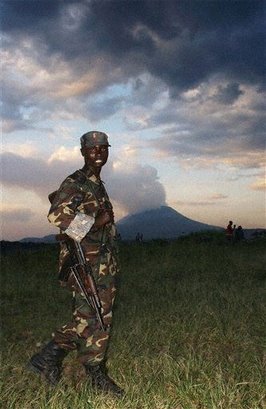
This AP file photo shows a freshly uniformed government soldier walking in the fields around Goma, with its active volcano smoldering in the background. Government soldiers of the FARDC, or DRC Armed Forces, are the product of a long and expensive process of security sector reform, in which all former combatants (including rebels, ethnic militias, and popular defense forces) are disarmed, demobilized and reintegrated (DDR) either into civilian or military life, depending on their capacities.Human Rights Watch recently released a report documenting a well known but troubling reality about the success of the country's DDR program : troops
from the 'new', reformed government army are responsible for massive human rights abuses, in particular the abduction of civilians for manual labor. Digging and sifting in open mines for coltan, diamonds and gold is one such activity, ostensibly to offset the lack of salary received from their superiors in Kinshasa.
"Congolese government soldiers were sent to Ituri to protect civilians against abuses by local militias, but they themselves are devastating the area," writes Alison Des Forges, Africa adviser at Human Rights Watch.
I will be in the DRC for the next six weeks, so expect more blogging from there. Especially as the 29 October elections approach. My camera was stolen on my last visit in June. I haven't replaced it, so will have to crib others' photos, alas.
Sunday, October 15, 2006
DRC: Democracy is no panacea
Writing this week for "The New Statesman", Michela Wrong, author of In the Footsteps of Mr. Kurtz and more recently I Didn't Do It For You, gazed with fresh eyes on the problems brewing in Kinshasa in advance of the 29 October elections."This is not hysteria," she writes, "the ingredients for serious trouble are all in place. A new form of xenophobia between Lingala-speaking westerners, who regard themselves as "sons of the soil", and Swahili-speaking easterners, rejected as "foreigners", is being stoked by television stations owned by the two candidates. Unpaid soldiers, whose wages are routinely pocketed by their commanders, roam at will. Both men control private armies that opened fire on each other after the first round of voting, leaving 30 dead, and have been importing weapons ahead of the coming showdown. Whoever loses is certain to denounce the results as rigged. Both Kabila and Bemba, after all, are men who owe their prominence to their readiness to take up arms, so why accept the verdict of the polls?"
She concludes, "If all hell breaks loose in the DRC after 29 October - and I desperately hope it does not - it will be tragic evidence of the damage a very human inclination to hope for the best can do."
But is exporting democracy--in this case with a $420 million price tag--the best the international community can do? Most ordinary Congolese lament the lack of tangible benefits to their individual lives and to society generally. Congo needs administrative structures, a capable bureaucratic class to operate these structures, and leaders capable of managing the mechanisms of modern statehood. Can such core necessities simply be bought? Of course not, only the Congolese can provide the human element.
Elections themselves are window dressing, all would agree, and if peaceably implemented, could lend legitimacy to Congo's status in a world of states. But as William Swing, the Secretary General's envoy to Congo, said last week in Kinshasa, if elections go well and the results are accepted by the losing party --but nothing improves in the country, then that $420 million will have been a complete waste.
Friday, October 13, 2006
Washington Post: UN reform falling flat
Yesterday the Washington Post editorial page published what amounts to an epitaph of reform efforts at the United Nations, in particular its Human Rights Council. The author described reform efforts aimed at the Council as having 'run amok', and as 'making the old one look good' ("Reform Run Amok").The old one, we recall, sported the likes of Sudan, China and Libya as Council member states. Attention was successfully diverted from Darfur and Uzbekistan, and focused exclusively on Israeli 'atrocities' in Lebanon and Palestine. The exclusive focus on Israel was possible, according to Mallaby, thanks to Council rules allowing one-third of its membership to effectively run proceedings unilaterally. 17 of the 47 member states happen to be partisans of a so-called 'Organization of the Islamic Conference', and are thus able to sustain their screeching anti-Israel rhetoric while Darfur burns, China and Russia imprison and murder their journalists, and Guantanamo persists.
The editorialist maintains, "For all its faults, the previous U.N. commission occasionally discussed and condemned the regimes most responsible for human rights crimes, such as those in Belarus and Burma. China used to feel compelled to burnish its record before the annual meeting. The new council, in contrast, has so far taken action on only one country, which has dominated the debate at both of its regular meetings and been the sole subject of two extraordinary sessions: Israel."
"[...] Human rights groups that supported the creation of the council, such as Human Rights Watch and Amnesty International, admit to being appalled by the outcome; they nevertheless argue that the panel should be given time to right itself. That could happen, they say, if the democratic members of the council organize and work with the same cohesion as the "unfree" states. They also suggest that the United States, which refused to join the council, reconsider."
Personally, I have tended to withhold judgment on the success or failure of the UN's declared reform efforts given their sweeping and comprehensive nature. They will take time, and lots of dead wood will have to go. One can imagine many insiders will resist the process, like derelict renters facing eviction. [Having waited a full five months to get paid for a job I did for UNICEF in May of this year, I know intimately the unseemly odor and ungainly heft of the UN's administrative dead wood.] But widespread reform is urgent and imperative, and many UN careerists admit this.
Kofi Annan rightly recognized that the logical starting place was to fix one of the most glaring blemishes on the UN's tattered face, that of its infamously dysfunctional Human Rights Council. Why exactly this failed so egregiously is unclear. Mallaby recommends cutting off US funding, as happened to UNESCO in the 1980s. The UN only further undermines its waning credibility by allowing such anti-Zionist forums to abide and prosper.
Wednesday, October 11, 2006
DR Congo: Amnesty Int'l claims child DDR programs are 'failing'
DDR is the process by which ex-combatants from rebel and government forces are disarmed, demobilized and reintegrated into civilian life. Those who pass certain tests are allowed to remain in the national army, the remaining adults are given a short-term stipend and some vocational training.Minors, of whom there were an estimated 30,000 associated with armed groups in the DRC, qualify only for civilian life. They are automatically demobilized and reintegrated because their association with armed groups is prohibited by international humanitarian law and a clutch of related international treaties and conventions specific to the rights of children. The work of de-militarizing their minds and acclimating them to school, village life with their family, the poverty and monotony of the life they left behind, is still an experiment. Programs differ significantly from country to country, as new methods are tried in light of past failures. The children dont get any 'better' at the programs, and are generally very difficult to work with, in addition to being violent.
In 2005 and 2006 I've been working in and evaluating several such programs in Burundi and DR Congo. It has been fascinating, but also enormously frustrating. There is always much to criticize in any aid program. Things rarely go as planned and measuring impact in highly insecure and fluid environments is notoriously difficult.But DDR is unlike any other aid effort because of its close links with human security and its centrality to the pacification of the country itself. It's no exaggeration to say that a poorly executed DDR program adds a new powderkeg to an already volatile situation, and can re-ignite widespread violence when participants decide to withdraw from the program. The consequences of poor performance in other types of aid programs, like emergency nutrition or medical services, do not include returning the country to war. This happened in Liberia: failed DDR programs in the late 1990s meant a return to war. A new

international commitment to bring belligerents back to the negotiating table took much time and money, and only then could another DDR program get
underway.

This week, Amnesty International released its independent investigation into the success of child DDR efforts in DR Congo, called "Children at war, creating hope for the future."
BBC covered the story, highlighting the fact that the "missing 11,000" children are girls "used as sex slaves by military commanders or regarded as dependents of adult fighters." Girls made up 40% of the children taken by armed groups during the war yet the vast majority remain unaccounted for, according to Amnesty. "A lot of them were used more as sex slaves and therefore the combatants are considering them as their possession or their wife," Amnesty researcher Veronique Albert told the BBC.
It is an accurate claim. Girls associated with armed groups--often abducted by force, sometimes joining voluntarily--have proven nearly impossible to access and get released by soldiers and rebels
alike. There are many reasons for this, most of them cultural: the end result is that many girls choose to stay with these men, with whom they now have children. Read Amnesty's press release here.
With the second round of presidential elections approaching on 29 October, I dont think the problems with the DDR program pose a great risk to a peaceful outcome. There is already enough hate speech circulating and private militias
waiting in the wings, to deliver a crippling blow to the country's recovery. Today's report about Kabila's party representatives in London getting assaulted by a mob of Bemba supporters is indicative of the overt tensions around elections.